Showing posts with label Book Reviews. Show all posts

Saturday, February 18, 2012

Book Review: Clive Barker's HellRaiser; Pursuit of the Flesh


Clive Barker's Hellraiser: Pursuit of the Flesh Volume 1
by Clive Barker & Christopher Monfette, Leonardo Manco (Illustrator)
Boom! Studies 128 pages

During most of my life Clive Barker has been my favorite author, as far as professional heroes go he is one of them for sure. He has had a rough go of it lately. Lots of projects and books have been promised and only half of those (mostly films) have seen the light of day. Publishing wise Barker was dropped by his long time publisher after failing to deliver a collection of horror shorts called the Scarlet Gospels.

This collection has been rumored for almost a decade, and...more

During most of my life Clive Barker has been my favorite author, as far as professional heroes go he is one of them for sure. He has had a rough go of it lately. Lots of projects and books have been promised and only half of those (mostly films) have seen the light of day. Publishing wise Barker was dropped by his long time publisher after failing to deliver a collection of horror shorts called the Scarlet Gospels.

This collection has been rumored for almost a decade, and was said to feature Barker's return to the hellraiser-verse with a story about the death of it's villain Pinhead. Delay, after delay followed. In part because what was supposed to be a short story about Pinhead, became a novella, then as Barker kept writing it became a very, very long novel. The Scarlet Gospels became a separate project and different short story collection was said to be on the way.

Neither happened, I suppose Barker and the publishing powers that be had different ideas on how to market the work. The publisher claimed Barker couldn't stop revising it, or that he got distracted by other books(Mister B.Gone, Abarat 3) and film projects. Who knows for real.

Hellraiser is one of my favorite films ever, I am sure for Barker it has special place as it was his first film as director. So like many Hellraiser fans he helplessly watched as shitty sequel after shitty sequel was made with Pinhead that seemed to have little to do with his story. Personally I have found even Hellraiser 2 which Barker was somewhat involved with doesn't hold up well.

Barker clearly fell back in love with the story while workin on the Scarlet Gospels. Good thing because he decided to get involved in writing this graphic novel series. Not only does it return to the mythlogy of the story but follows the first stories heroine Kristy Cotton. After 25 years of haunting memories a trip to hell and back she has devoted herself to destroying the box and any gateway to hell.

Pinhead on the other hand is bored. The pain and pleasure is all getting to be tiresome. Barker seems to be building up the character for a rebellion against hell. This is classic Barker, weird tools and gadgets. Deep non-traditional mythos, and erotic horrors abound. This is the first Hellraiser story, since the first film that I could really get into. The art is perfect and disturbing.

Is it perfect? Besides a Pinhead that is a little to talkative and a throw-away lover for Kirsty it's pretty close to a perfect Hellraiser story

Wednesday, February 15, 2012

Book Review: By the Time We Leave, We'll be Friends by J.David Osbourne


J.David Osbourne is an asshole. You know the type, The first time they
pick up a guitar they can play a power cord without any help. They
know how to ride a skateboard and do tricks the first time they try.
This is a first novel. An amazingly good, taunt fucked up mind binder
of Dark Bizarro that is so well crafted you wont believe it's a first
novel. I know, what an asshole. He should have to struggle through a
few good but not quite there novels before writing a masterpiece like
the rest of us. What a jerk. I am not the only author jealous of this
book, might the only one to come out and say it.

So you want to here more about the novel. Lets start by saying this
won the 2010 Wonderland award for Bizarro novel of the year. It is the
story of a Russian gulag in 1950's Siberia. The story follows a couple
different characters but focuses much of it's attention on Former
thief and prisoner, Alek Karriker. things change for Alek when he is
promoted from prisoner to being a guard.

This gulag setting is perhaps one of the most bleak locations for a
novel you copuld possibly pick. So of course that interested me the
first time I heard about this novel. Are you really goign to escape
when hundreds of miles of tundra are on the otherside of the fence?
This is a miserable place and opium is one of the few things that
helps to take Alek's mind off the conditions that he and prisoners
alike deal with. One problem he has is a hole in his neck is talking
to him. At the same time the prisoners are losing their minds to drugs
and depression.

So why not try to escape? It's insane right? There is no vegetation or
food in sight for hundreds of miles. That sets of the kick in the
pants that Karriker has in mind for making it to freedom.

Well this novel is total insanity and I will only fail to give it
justice. It's all well researched and written. It's compelling and
impressive in every way. Swallowdown publisher Jeremy Robert Johnson
has an amazing eye for dark horror themed Bizarro and so far batting
five for five on masterpieces.

As often happens with masterpieces it's only weakness is also a
strength. I admit I have no idea what happened at the end. Of course
the first time I saw Muholland Drive I was totally confused, second
time I totally got it. the fact of the matter is I will read this
novel again someday and I predict I will feel like Moron for not
getting it the first time. Either way J. David Osbourne will still be
an asshole for writing this amazing first novel

Sunday, February 12, 2012

Book Review: The Devil's Coattails Edited by Jason V. Brock and William F. Nolan


The Devil's Coattails Edited by Jason V. Brock and William F. Nolan
Hardcover 288 pages
Published by Cycatrix Press

Featuring: Ramsey Campbell, Jason V Brock, Dan O'Bannon, John Shirley, William F. Nolan, Melanie Tem, Jerry E. Airth, J. Brundage, James Robert Smith, Norman Corwin, Steve Rasnic Tem, R. C. Matheson, Earl Hamner, Sunni K Brock, Nancy Kilpatrick, Paul J. Salamoff, Marc Scott Zicree, W. H. Pugmire & Maryanne K. Snyder, Richard Selzer, Gary A. Braunbeck, and Paul G. Bens, Jr. Illustrated and with a cover by Vincent Chong.

There are thousands upon thousands of horror fiction anthologies featuring over a bazillion horror stories. What separates one book from the masses, that is what editors should consider before starting one of these projects. During the 80's (the publishing glory days for horror) some of the best anthologies were classics like Doug Winter's Prime Evil, Kirk McCauley's Dark Forces and the Night Visions/Shadows series edited by Charles Grant were among the best.

The Grant anthologies come to mind here, when I was a young horror reader I got excited each time I went to horror section and saw the latest edition of Shadows or Night Vision ( which continued for a few editions after Grant's death). I couldn't wait to open the book and see who was in the table of contents. After reading the first anthology (the Bleeding Edge) edited by Brock and Nolan I was excited when they said they were already working on a second book.

That was great news to me, the Bleeding Edge was in many ways the most solid and ground breaking anthology in the genre of Dark and weird fiction in some time. First it was amazing quality of paper and production. It is the kinda of book you want to take care of, It looked the treasure that it was. Second, the authors represented spanned several generations ranging from 60's favorite Ray Bradbury to 80's fav John Shirley, but don't worry young hip-snappers like Cody Goodfellow and Lisa Morton are also represented. Last and probably more importantly was the bold decsion to include several formats from Screenplays, teleplays, poems, fragments and not slaving simply to the idea of a straight prose collection.

The second book by the duo is not as diverse in formats (it does have a poem by Nolan and teleplay by Twilight Zone expert Mark Zicree). Almost the entire book is filled masterpieces, and I can only say two stories didn't work for me, both by authors whose work I respect. I love Gary Braunbeck, and consider his horror novel Prodigal Blues to be a masterpiece, but his story in this book lost. I admit it probably went over my head, and that being at the end. The WH Pugmire appears to be set in his personal mythos and I felt a bit lost, I intend to go back and read it after I have explotred more of his work.

The three best stories in my opinion were “Best Firends” by Melanie Tem, "Invisible” by Nancy Kilpatrick and "If you Love Me" by Paul Bens Jr. Tem's “Best Friends” is a Stoker award worthy Ghost story about a woman haunted by the ghost of someone who is still very much alive. Kilpatrick's “Invisible” is a good story for people who complain about the service at restaurants might give them a lot to think about. “If you Love Me” is a deeply haunting tale about changing attitudes about AIDS in the gay community, it is a a brutal heart breaker and perfectly caps off the end of the book.

This is a beautiful, amazing and special book. The problem is this is a serious collectors item. It is a $150 dollar book and it looks like it. It ain't cheap. Not sure if Brock and team are planning Trade editions ever. I hope so because the masses should read this book.

Book Review: Primal Screamer by Nick Blinko


You may not have ever heard of Nick Blinko, but he is well nown and
popular in certain circles. He was the guitarist of Rudimentary Peni,
a popular crust punk band. (crust punk is a subgenre of a subgenre,
anarcho-political punk) besides their fellow British standard Crass -
Rudimentary Peni is one the most popular bands of the genre 30 years
after they started.

Since the band recorded a tribute to HP Lovecraft I think the idea
that the novel was a twisting of Crust punk with Lovecraft vibe was a
little over sold on the back of the book. Besides a single reference
to the Necronomicon, and standard Gothic feel this thin but powerful
novel didn't feel Lovecraftian to me, and the horror aspect is a bit oversold.

The more you know about this pioneering band, the more likely you
are to enjoy this novel, which is a paper thin autobiography. The
novel follows the event of Blinko and the band's life with only a few
names changed and a few horrific visions added. the rumor is that
Blinko himself has been committed, but I don't know if that is just
legend. It's true that the band's bass player died of cancer.

One very bold choice was to tell the story through the eyes of Nat
(although it's clear he represents the author)'s psychotherapist. As
he gets to know Nat he feels his dreams slipping into insanity, this
and the method of regressive therapy which takes you back under
hypnosis to feeling of being in the womb. This is a great analogy
considering the name of the band the characters and the author were
in. In Maximum RocknRoll, issue #237 (February 2003), the bass player
Matthews explained how he came up with the name of the band: "When I
was at school studying biology, we were told that in the fetal stage
the clitoris is a rudimentary penis."

Over all I personally enjoyed the novel, but I didn't exactly think it
was a masterpiece. As a history of the band and a dark artist knowing
so much of this experience is true makes for a compelling read. At the
same time as a horror novel I don't think it would work for anyone who
was not already a fan of or interested in Blinko's music. The
therapists descendent into madness to me feels short and rush at the
end, happening most clearly in the last five pages of the novel.
Events of the story while interesting and gothic were not strong
enough to carry it as a horror novel.

Tuesday, February 7, 2012

Book Review: The Complete Strain Trilogy


The Complete Strain Trilogy

In Hollywood terms writing and directing an Oscar nominated film gives you the weight to throw around and get the projects made that you have been dying to make. Guillermo Del Toro was one of my favorite directors long before Pans Labyrith. I think he is one of the most exciting directors working in genre today. Since his huge surprise Spanish language hit Del Toro has failed several times to get projects off the ground, some were to grand in scope (At the Mountains of Madness) or to delayed in production (The Hobbit). He has still been up to some exciting things including producing films(Don't be afraid of the Dark) and co-writing a trilogy of vampire novels called the Strain.

The project that began as a TV series pitch by Del Toro (who pointed to HBO's The Wire as influence) with the structure of the novels following three possible seasons of the show. It is really to bad that idea never became reality, but Del Toro was not prepared to put this idea to death. Del Toro is a talented writer and storyteller who knew he needed help with some of procedural details that were important to the first book. So he teamed up with noted crime fiction author Chuck Hogan, known for his bestselling novel Prince of Thieves (made into the film The Town).

Depending on who is commenting on the novels, you'll see comments suggesting that “it is clear that” Del Toro or Hogan did more of the writing. Both authors went at length to suggest that neither did heavier lifting during the writing process. The only thing we know for sure is that elements of both authors show up and the duo made for a great story telling team.

The first book in the trilogy starts as a slow burn, focused on the mystery of a plane that lands in NYC with a load of dead bodies. It is a great set-up for a medical mystery thriller, similar to Andromeda Strain or an early Robin Cook novels. During this first act Hogan's skills for unfolding a mystery, and GDT's monster and mythology skills are perfectly balanced to give the book a very strong atmosphere. A lot of this first book is setting the rules, mythology and characters.

I have seen a few reviews that said the characters were lacking and that was not the case for me. The novel is told through several very notable and likable characters. The hero of the story or focus is a recently divorced father and CDC investigator Eph Goodweather, but other characters included an old world vampire hunter Setrakian , a Mexican wrestler, a rat exterminator Fet and several Mexican gangsters trying to survive the end of the world. Not to mention the vampires which included the only half breed naturally born vampire referred to by the vampire master as “The Born.”

I enjoyed the characters and thought they were developed with such a slick touch that (screenwriters have to rely on) most readers might not have noticed. Some authors writing epics will spend a hundred pages building characters that can be established in less than page. This is the case here.

All of this sets up the story of The Fall, which lends itself to kicking ass. The first book filled with world building and information dumps, but it's a lot of stuff as a novelist you have to do. How do the Vampires work? Who are the characters? What are the rules. So for book two we have all those things established and we are ready to rock. Even though I knew it was an end of the world story involving vampires I found the process still included a deeply shocking ending.


I knew I would dig this book, I love a great end of the world apocalypse novel, McCammon’s Swan Song is perhaps my favorite and while it’s not as sprawling as Swan Song or as intimate as I Am Legend, The Fall strikes perfect balance. Not too long, not a lot of wasted fat, the story cooks along at a great pace. Del Toro's cinematic editing and pacing skills became clear towards the end of this second book which worked very well with Hogan's skills for writing action. At the end I was left stunned and dying to read the third book.

Building an epic is easier than ending one. Ask most fans of Stephen King's the Stand or IT which are crazy long well told stories that left most readers unhappy. They still love the books, but something about the end has not sat well with most readers. From a lot of the fan reaction to the Night Eternal it is clear that a few fans felt let down.

I think the second part is the best of the Trilogy, but the Night Eternal to me was a satisfying entry into the series. I think there were a lot of interesting ideas and creative issues that the authors touched on that could have been expanded, but for the most part the story is told with a tight focus. I was impressed with the tiny moments from the first two books that payed off here, IE the international space station.

My only problem with this entry in the trilogy was a misguided attempt to connect the story to judeo Christian myths, to me this undid some of the power of the first two books and almost contradicted the story. In the end I am was happy the trilogy and think it is a major accomplishment that should be enjoyed by all horror fans. My hope is that Hogan and GDT will work together again and if not that we have not read the last Del Toro novel.

Monday, January 9, 2012

Book Review: The Devil Next Door by Tim Curran


The Devil Next Door by Tim Curran
333 pages
Severed Press

In 2005 John Hillcoat directed a Australian western named The Proposition. I went to see this movie in the theater, it's one of those movies that has to be seen on the big screen to work. It is by far the dirtiest movie I have ever seen,and by that I mean dirt - dirt. Flies buzzed on the screen, you could almost feel the sweat and grime. After the movie I felt like I needed a shower. Name any gore movie you like I still consider it to be the most visceral movie I have ever seen.

Now this novel had the same effect on me, don't even consider this book if your mind cannot handle thinking about bucket after bucket of blood,sweat,poop and general slime. There are two kinds of gruesome horror novels ones that use the viscera to season a strong story like Poppy Brite's Exquisite Corpse,Early Clive Barker or John Shirley's Cellars to name a few. The other kind of gore novel just strings together demented acts with a paper thin connection and fails to tell a story or build characters. I am glad to say Devil Next Door is more than just exploitation, well it's still exploitation, but it also tells a story and still has somewhat of moral center.

That is a tough balance to strike when you have a book filled with Murder, rape, cannibalism as Civilization crashes down into wild insanity. It's the story of a man named Louis who is one of only a handful of people in a small fictional Indiana town named Greenlawn. over a long day the people in the town begin to lose their minds, one violent act after another builds until the whole town, and every where beyond turns towards wide spread brutality.

The story is not that original I mean my first thought was Romero's The Crazies, I have heard comparisons to Simon Clark's Blood Crazy(which I have not read yet) but really I enjoyed the story telling enough that I just rode with it. Curran does an excellent job building characters, even the secondary ones pop to life quickly. The thing that creates this madness is interesting and creates a subtle environmental message. Once things starting to hell it gets super,duper bad.

At that point the madness is on, every base lust, desire, or emotion gets free reign. To me the finest and most creepy moment in the novel came when the main characters called 9/11 to get help. Someone answers, but all they hear at first is breathing. It was such a great moment of expressing the terror at losing something we consider a safety net of society. Just Brilliant.

Was it a perfect novel? No, but I now am sold on the author and want to read more of his stuff. There were minor plot holes(nothing I couldn't over look) and I am pretty sure human's stripped of civilization might not act that awful. Then again the true horror of this novel trying to survive in a world where Civilization is torn from us. If it happened like that insanity is just the beginning. Can't miss for fans of end of the world novels or extreme horror.

Thursday, December 29, 2011

My Top ten reads of 2011

I read 73 novels, short story collections or fiction anthologies during this year. As a sometimes reviewer for the website Monster librarian I get free copies of new books. Not all of them are great, but as a perfect reviewing the book I have to finish it. As a writer that is not such a bad thing, you can learn a lot from a book that totally fails. I am also exposed to a lot of books by genre authors as many of them are my friends. That being said I am brutally honest and would not put a book this list if I didn't think it deserved to be there.

I read a lot of books that were new books this year but I decided to rate my favorite reads this year despite when they released instead of last year when I only did books released during the the year. So if the title has a * by it then it means it is a older book.

10.Through Darkest America* By Neal Barrett Jr. (Issac Asimov Presents)
259 pages (Out of Print)


This might be one of the most important works of speculative fiction I have ever read and it's only dumbluck that I read it. The story works as a coming-of-age story, it works as a post apocalyptic epic and most of all it is a gritty tale of the wild west. More than anything it is a slap in the face that explores many issues.

This novel takes place after a devastating war, and in this future a class of humans are bred to be “stock” as food. You see Stock are not human – they are just stock something less than human. It explores issues of speciesm better than any PETA leaflet I have read in a long time.

9.The Five by Robert McCammon Subterranean Press $26.95

The Five is the story of a struggling rock band who the novel is named after. The Five is a thriller, and road novel about rock and roll but it's subtext comes to the surface about 375 pages into the book. At that point the message becomes a little heavy handed, but that doesn't matter one bit. McCammon is so skilled at pacing and characters that you are so invested in the story that you'll realize the subtext was peppered through out.

There is a moment when the message is pushed to the surface. But I liked it. The Five is a novel about the tapestry of Rock and roll, the universe of live music, what it all means. The Five works on many, many levels. It's a masterpiece written by a man who has a few of those.

8.The Fall by Guillermo Del Toro And Chuck Hogan

The second in a Trilogy of Vampire novels finds the vampires wiiining and ending the world as we know it. I knew I would dig this book, I love a great end of the world apocalypse novel, McCammon’s Swan Song is perhaps my favorite and while it’s not as sprawling as Swan Song or as intimate as I am Legend the strikes perfect balance. Not too long, not a lot of wasted fat, the story cooks along at a great pace. The film editing and writing influence GDT brings to the table works really well in this novel.

7. Jim and the Flims By Rudy Rucker 247 pages $24.99
Nightshade books


While Rucker is not thought of as a bizarro author or apart of the bizarro lit scene this is to me me the best bizarro novel I read during the year. This novel is weird, funny and above all smart creative Science Fiction. The story of a surfer slacker scientist who travels to the afterlife to try and find his wife may not sound that original but once Jim gets there it gets super weird.

What we end up with is a novel that is kind of like Matheson's What Dreams May Come' meets Slacker. I can hardly do the novel justice in this review. In Flimsy water flows across the sky, flying intelligent beets, and blue baboons run amok. The characters travel across the land on a cruiser couch that Jim makes with his mind out of a material called Kenessce which all flimsy is made out of. Along the way the book also has has one of the most bizarre sex scenes between Jim and a woman also discovering her astral body. Loved this book.


6. In Extremis: The Most Extreme Short Stories of John Shirley 320 pages
Underland Press


It's no secret John Shirley is my favorite author. The extreme nature is found the unflinching peek into the dark realms of the human condition. Opening this book is like staring through one of the worst peepholes you can imagine. There is no author working in the horror genre today that does a better job of shining light of the horrendous human condition while maintaining a moral center.

5. We Live Inside You By Jeremy Robert Johnson 188 pages
Swallowdown press


We Live Inside You is the long awaited followed to Johnson's amazing first collection Angel Dust Apoclayse. It is dark bizarro horror literature at it's sharpest point, sharpened enough to enter through the temple and worm deep into your brain. JRJ comes from the same scene but doesn't rely on dildo jokes or B-movie tropes like a lot of bizarro writers do. The insane ideas are still there, but it's like crème filling in a fancy donut. At the same time it's hard for me to advise anyone to take a bite of a book written by a guy who keeps a list of parasites above his desk, but this book is a must for lovers of all literiture that is weird and dark.


4. Fathers and Sons: Blackguard (Book one) By Edward R. Morris 242 pages
The Borgo Press


Morris wears his influences on his sleeves like patches sewn on on punk rock leather jacket. What we end up with is an edgy novel that is not quite cyberpunk, military sci-fi, First Contact story or distopia. It is all those things and more. This is the first in a series that blurs the many sub-genres of speculative fiction in to a potent cocktail. A work of high literature that explores characters forced into the chaos of an all to possible future. Like a Portlandia dystopia sci-fi readers here in rip city will enjoy seeing the dark but possible future for our city.

3. Ex-heroes * Permuted Press 274 pages


It would be easy to describe this novel as Watchmen with Zombies but that sounds cheap, it's not. To me Ex-heroes is the best serious zombie novel I have read since the explosion of zombie trendy madness. The suspense beats work and there are true moments of terror in the novel, not an easy thing to pull off when most of your characters are super humans. Clines also manged to disturb me in a scene where a zombie mother drags her living dead infant down a street with a rope tied to her waist. He left that to our imagination, and for me I shuddered at the thought of the dying mother not wanting be separated from her child even in death. Brutal. Excited to read the sequel.

2.Should Have Killed The Kid by R. Frederick Hamilton 300 pages $12.95
Legume Man Books


This book is filled to the brim with very unpleasant situations, but if your a fan of good creepy unsettling horror fiction then that is what you are looking for. Should have killed the Kid is a supernatural Apocalypse thriller which has both Lovecraftian vibe (without direct connection to the mythos) and an extreme horror feel. At first I thought of it as Stephen King's The Mist with A Quentin Tarantino structure, but after the first 100 pages the structure smoothes out into a linear fashion. I always say that great suspense novels feel like climbing a very tall unstable ladder. And that is what I felt like I was doing when I read this novel.

Is it the second best book I read of the year, probably not but I only enjoyed reading one book more this year...

1.Old Man's War* by John Scalzi

Last year while writing my novel Goddamn Killing Machines I swore off reading novels that were in the same military-action Sci-fi Drama. After I finished it author Nick Cato mentioned this novel to me. So I picked up a used copy and started reading it on a flight home to Indiana. I could not put the book down, reading half of it in the air.

The most perfect and solid piece of Military Science Fiction since Handleman's Forever War. This novel is Star ship Troopers meets the Twilight Zone's Kick the can episode. Old Man's War seems to be taking a stab at American exceptionalism.

Once at War the novel goes crazy with fantastic science fiction concepts and ideas. I was pleased the universe was not populated by humanoid standard fill in the blanket human like aliens there is a great gee-whiz factor to this novel but it all works and Scalzi has created a world I am excited about revisiting in the next three books that continue the story. Infact I liked it so much I am saving the sequel for the right time. Sure sign that I loved it.

Monday, December 26, 2011

Book Review: Pontypool Changes Everything by Tony Burgess


Pontypool Changes Everything by Tony Burgess
280 pages
ECW press

I discovered this novel from watching the film based loosely on the novel. The film Pontypool was released a few years back and quickly gained a rep for being a well written and composed low budget zombie film. When I saw it I thought it was a creative spin on the tired genre, most interesting at it's core was a original concept of the the zombie virus being transferred not by blood or bites but trhough human language. I was interested in novel because it was written by Burgess who also wrote the screen, and during the commentary track he said the novel had a larger scope.

Probably due to it's thin budget the movie takes place at a small radio station in Ontario, and focuses on the main character an aging former shock jock named Grant Mazzy. Mazzy keeping his career alive by doing weather reports on backwater radio. The film gets a lot of of it's rich tones by Stephen McHattie's performance as Mazzy. Since the setting is confined mostly to the station the actors have to carry a lot of the story. It's a character driven horror film, that manages to transcend it's budget like a lot of great low budget horror films.

So I was excited by the idea of reading the book. This is a rare case where I think the movie is a lot better than the source material. They are very, very different stories and while they share Grant Mazzy as a main character and plot device the novel lacks the vivid strength of character which drove the film.

Burgess is an excellent word smith, I can honestly say it's some of the smoothest and interesting prose I have read in a long time. That being said writing pretty paragraphs and telling a good story are two totally different things. I spent a lot of my time reading this novel confused, and according to some of the online reviews I was wasn't alone.

I don't mind being confused if the story is exciting and it's important that the confusion is paid off with answers. There are some intense and powerful moments in this book that's why I kept reading even though I was often frustrated and confused by the lack of clear narrative. Since the zombie outbreak is transferred through the language there are some very well composed moments of suspense that happen inside the mind of the infected. I also enjoyed the moments where some characters tried hard not speak at all.

This novel is clever, perhaps a bit to clever for it's own good. Could the novel itself spiral into maddess of disrupted language like the victims in the story. Maybe, but I didn't really see that either. It's an interesting experiment, one I don't think worked. I'll admit many I didn't get it, but I am a pretty savy reader, who has personally played with experimental narratives, so if I don't get it then it is a good chance most readers will be lost.

So here is the hard part for me, I respect the well written inventive prose but can't make much sense of the story. This made the book a slog, and I can't say I enjoyed much of it. The movie expressed the idea in a more clearly, and succeeded as a story.

Saturday, December 17, 2011

Book Review: The Gods Themselves by Issac Asimov


The Gods Themselves By Issac Asimov
Classic printed in several editions

So I named my cat Asimov. I consider Asimov's Lucky Starr novels as the books that got me excited about writing and story telling, and Azzy just sounded like a robot when she walked in our back door. I have a soft spot in my heart for the man that almost published a book in every part of the Dewey decimal system. Besides being the geek's geek Asimov was also a committed environmentalist before he died in 1992 having written a non-fiction book on the topic ( of course he did) called "Our Angry Earth."

Being a militant environmentalist and Asimov fan it's strange that I have not read his Hugo and Nebula award winning environmental novel (released in 1972) The Gods Themselves. I thought I had read it before but I had confused it with Nemesis one of the last novels the grandmaster of Science Fiction wrote.

I enjoyed this novel, but this is a hard science novel that is for serious Sci-fi or environmental nerds. I can't tell you this is must read, but it presents interesting ideas. Is it worth the time you'll put into the book. Not sure.

The story is split into three separate novellas. Each could stand alone, but they are not really meant to. So read them together if you plan to. The first Novel is about a scientist who accidentally creates an unlimited power source, eventually one of his rivals discovers that the energy comes from a transfer between our universe and a alternate dimension. The trick is you'll have unlimited power but it's a good chance you will cause the death of the sun. Kinda important to life on earth. Opps.

The second novella is about that alternative universe. This part is really interesting, instead of just adding a beard and diabolical plans to the people of this para-universe Asimov goes super bizarro. The society of this universe and the people in it are not human in the least. Society is divided into three units and their families are super different from ours. Part of it is some of the people are not physically solid in the world. You see there are hard ones, and the soft ones who can travel threw matters. The third unit are emotionals which is only really important in my eyes to how the characters and the fictional society operate and effects the plot less.

This second part is a reaction to Asimov's early 70's critics who called him a prude so there is tons of of para-dimension sex just because. The important point to the story is how these very different people react to the impending doom created by the energy transfer.

Both of the first parts end with Twilight zone-ish twists that lead directly into the next part so the third kinda ends with a dud. It comes back to the future on a moon base in our future. I can't really talk about it without spoiler. So stop reading if you plan on reading this novel. The end is a ho-hum anti-climatic solution to the crisis created by the energy transfer. When I say it's ho-hum I when it is not the twist of the first to parts but it is thought provoking. Because in order to off set the problems created by the energy transfer the scientists effectually create another big bang, perhaps they have started a new universe. They don't really know, but maybe they did.

I think Asimov was trying to say the answer to environmental problems can be found in science, that we need to look for creative solutions. Life comes from life, and there is a universe of possibilities.

Book Review: The Eye of Infinity by David Conyers


The Eye of Infinity
by David Conyers, Mike Dubisch (Cover Illustrator), Nickolas Gucker
(Illustrator), Cody Goodfellow (Introduction)
84 pages perilous Press

Probably my favorite thing about this thin little novella is that David Coyners while firmly writing in the Lovecraftian mythos is not trying to write like Lovecraft or setting this novel in 1930's Rhode Island. This modern take is the kind of mythos I enjoy. Probably the thing I liked the least about the book was how short it was. There are some serious major cosmic themes going on and all we get is 84 pages? I could taken another 150 at least.

I am not asking the guy to over write, and certainly this book is well written. The art and the general presentation is well done and looks cool. I am glad I bought this book. That being said it reminded me of my reaction to Quintin T.'s Inglorious Basterds. I loved that movie, but really only got twenty minutes of the WW II men on a mission movie that was sold to me in the director's interviews.

In Cody Goodfellow's introduction we are promised a James Bond meets mythos like spy vs. soggoth Lovecraftian show down. The books delivers in lots of ways. I was little bummed because there is a format to a Bond story, and I was looking forward to seeing that format/formula set against a cosmic horror back drop.

Right now alot of you are probably glad the author didn't take the path I'm talking about, this is a better less predictable story because of that. I think I might have enjoyed a traditional more predictable by the numbers spy thriller poltline, but that doesn't mean it would have been better.

None the less this is a short, but jam packed title that left me wanting more. That is a sign of a good read. Cool book, I am first in line and excited for the further adventures.

Saturday, December 3, 2011

Book Review: We Live Inside You by Jeremy R. Johnson


We Live Inside You By Jeremy Robert Johnson
188 pages
Swallowdown press

Thanks to an insanely cool book cover and equally intriguing title
Jeremy Robert Johnson's book "Angeldust Apocalypse" became a cult hit.
The blurb from Fight Club scribe Chuck Palahniuk calling him a dazzling writer didn't hurt either. Perhaps the best marketing accident came when very few people who bought it realized that it was short story collection and not a novel. Ok, that might not have been an accident because the reality is collections never sell close to the units that novels do.

That's OK because once people ripped open the package from amazon they were treated with one of the most insane over the top dark bizarro collections all time. If you have not yet read that collection I'll give you hint you'll want both these books up on your shelf keeping each other company.

Johnson is the Bram Stoker award nominated co-author (With artist Alan
Clark) of the amazingly dark illustrated anti-drug novel Siren Promised. He is also know for having written a short story about a dude that makes a suit of cockroaches to survive a nuclear war which was spun off into a separate novella called Extinction Journals. After a hypernation period where Johnson hung out with his human spawn and complied a list of germs and parasites Many of us wondered if JRJ would write again.

He came out of hiding first to publish a collection and novel by bizarro horror berserker Cody Goodfellow and rumors of a new collection by Johnson himself were rumored. I saw a few of the stories here and there in magazines like Dark Discoveries and Cemetery Dance but it was not until I had We live Inside you in my hands that I was totally sure.

I am so glad he did. Angeldust was a strong collection but the growth in the writing between the first and his second collection is like a out of control virus. The best horror writers chase their fears and in this collection Johnson rolls around in his worst fears. It is no surprise that Johnson has a list parasites and viruses on his
wall. If I have sold you and are worried about spoilers, click off this page go to Amazon and buy it.

The collection is separated into to two sections, the second being short pieces Johnson wrote with co-authors and a extended version of a story that appeared earlier. It's funny two of my favorite pieces are one page flash fiction type stories that pack amazing punch into bare number of words used. My favorite being “Cortical Reorganization,” which was a super powerful one and half pager about a spare changer. Other favorites include a dark Sci-fi piece called “The Oarsmen,” a Portland crime piece called “Persistence hunting,” but my favorite is a horrific tale I first read in Cemetery Dance magazine called “ A flood of Harriers.”

Flood of harriers, created a stir when it was first published, despite being semi-autobiographical and based on real events Johnson was accused of being borderline racist. Frankly I laugh at that, the story which happens to include a a few native American thugs is far from racist, and leads me to believe the people who were upset didn't read the entire fantastic story. It is my favorite in the collection because it starts off as a realistic and effective suspense tale before shifting seamlessly into a surreal body horror Karmic revenge direction. Well done.

We Live Inside you is dark bizarro horror literature at it's sharpest point, sharpened enough enter through the temple and worm deep into your brain. JRJ comes from the same scene but doesn't rely on dildo jokes or B-movie tropes like a lot of bizarro writers do. The insane ideas are still there, but it's like crème filling in a fancy donut. At the same time it's hard for me to advise anyone to take a bite of a book written by a guy who keeps a list of parasites above his desk, but this book is a must for lovers of all literiture that is weird and dark.

Saturday, November 26, 2011

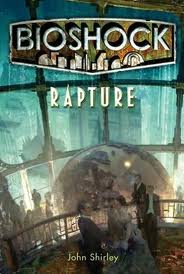
Book Review: Bioshock: Rapture by John Shirley


BioShock: Rapture by John Shirley
430 pages
Tor

If you have followed my blog at all you might have picked up on the fact that my favorite author is cyberpunk legend John Shirley. I am not a fan of the video game, infact I really never ever play modern video games. Infact the first time I ever heard of Bioshock was when Shirley let the cat out of the bag on this project. I really wanted to look at this as an original Shirley piece. It's not that at all, the characters and setting are not really in a Shirley vibe. That is not to say that he wasn't the perfect choice for this book because he really was the best possible author to write this novel.

Rapture is the name of the underwater city that is the haunted house type setting of the the video game. This novel is the prequel that tells the story of how the dream of hyper-capitalist right wing tycoon Andrew Ryan rose and fell. Considering the political upheaval in the story I see why Take-Two thought John Shirley was the person to write this.

Andrew Ryan saw Rapture as the libertarian dream, a nation under the seas hidden from nuclear war(this was in shadow of WWII and the coming cold war) and a chance for the free market to reign. This is the theme of Shirley's upcoming novel “Everything is Broken.” So Shirley does a great job of exploring the challenges that the “free” market of hyper-capitalism would go through in such a packed intense environment.

As someone who never played the video game those are the most interesting parts, not to mention the variety of characters that Shirley had to create to populate this world. The character who becomes the major point of view is the city's plumber (turned bar owner) Bill Mcdonagh who Ryan trusts long after Bill has lost his faith. By that point such a spirit of fear and mistrust has over taken the city.

The weak point for me, probably wont bother anyone who plays the video game. Once the genetically engineered worms that give people super powers showed up I realized Shirley was having fun setting the stage for a video game. I am sure that back story will be fun for anyone who has spent hours playing the game. To me it seemed left field, but like I said I never played the video game.

It seems that Bioshock:Rapture will deepen the understanding and texture of the world created by the video game. That game is considered by many to be one of the smartest out there and the creators of the game found the right author and I think they have done the fans of the game a favor. If your not a fan of the game already I suggest sticking to John Shirley's original cyberpunk like City come a walking or Black Glass.

Friday, November 18, 2011

Book Review: Ex-heroes by Peter Clines


Ex-heroes
permuted press
274 pages

It helps that I read a novel right before this one that I could not stand, but either way Ex-heroes is one of the best novels I read this year so far. It would be easy to describe this novel as Watchmen with Zombies but that is cheap. To me Ex-heroes is the best serious zombie novel I have read since the explosion of Zombie trendy madness. I know I wrote a Zombie novel myself, but if you noticed it was a satire and most of the modern novels make my eyes roll just in concept alone. The reality is that the concept of this novel probably would have caused the same knee-jerk reaction from me if I had not had this book recommended to me by someone I trust.

It would be easy to look at Clines Bio and think that the author was thinking of Hollywood pitch session when he came up with the story. "It's superheroes with zombies," while not a ground breaking concept (see Marvel Zombies), and sure it sounds like a cheesy Hollywood pitch but it doesn't matter. Why? For starters this story is so well told nothing else matters. Clines organized the plot and told the narrative so well that the novel crackles with story telling intensity. Clines told the shit out of this story.

The Story is set in post zombie Apocalypse LA, where a group of former super heroes help a group of survivors live on inside the walls of a Hollywood studio complex. Instead of zombies the walking dead are referred to as Ex's, as in ex-human. Secret identities lose meaning, and the struggle that is life after the end of the world takes a turn for the worst. Could it be that ex's are getting smarter or is their a super villian out there ready to fight the heroes.

The story is told in a non-linear fashion set up in “Then” and “Now” structure. The now chapters are told in third person and the flashbacks revolve between separate first person narratives. In the hands of weaker authors the first person narratives switching voices would not work, but they are perfectly placed in the story so they make sense. Depending on what the story needs the flashbacks either explain previous chapters or set up the chapters ahead in the story. This is all done with a drummer's perfect rhythm.

This is a strong novel so what could possibly make it stronger? “Stealth. Gorgon. Regenerator. Cerberus. Zzzap. The Mighty Dragon. They were heroes, vigilantes, crusaders for justice, using their superhuman abilities to make Los Angeles a better place.” The characters are original and interesting superheroes, which considering how many have been done in the last century is saying something. They are also rich and written with emotional depth.

The suspense beats work will and there are true moments of terror in the novel, not an easy thing to pull off when most of your characters are super humans. Clines also manged to disturb me in a scene where a zombie mother drags her living dead infant down a street with a rope tied to her waist. He left to our imagination, and for me I shuddered at the thought of the dying mother not wanting be separated from her child even in death. Brutal.

I could nit-pick some of the dated humor that comes with cheap jokes about celebrity zombies, but really I laughed most of the time. This really is a near perfect genre mash-up novel. Everybody who knows me, knows I am hard sell as this is a genre I have mocked in my own novel. I am excited for the sequel, and intend to follow the author in the future.

This novel needs to be a movie. Paramount or Warner bros should be in octagon fighting for this one.

Saturday, November 12, 2011

Book Review: That Which Should Not Be by Brett J. Talley


That Which Should Not be by Brett J. Talley
259 pages
Journal Stone

There must be something wrong with me because I really did not like this book. Apparently a lot of other people disagree with me. so keep this in mind when you read my review. This book has forty-eight almost perfect reviews on Goodreads.com and over two dozen on amazon. I hate to say this because I love to support new authors and certainly I can imagine the hard work Talley put into this book. I have to be honest...I really didn't like this book. Worse I struggled, I mean struggled to follow it or get to the last pages.

It is the story set at Lovecraft's fictional university Misatonic and is told by four revolving characters. So one of the main characters is Carter Weston, he is asked to search a nearby village for a book called the Earth, Incendium Maleficarum, (The Inferno of the Witch). Along the journey he is exposed to several myths and legends that relate to the book.

I should point out that I am not ethically opposed to the use of Lovecraft's mythos by modern authors, and I also have read and enjoyed plenty of period horror by Lovecraft, Smith and Blackwood. So it's not that I don't get it. Talley has been praised for perfectly grasping and using the period voice and and writing in that style. That is the root of the problem for me, and I admit when it's a first time author it will cause my eyes to roll more than ever. People complain about vampires and werewolves becoming derivative and they are, but come on it's the 21st century and writing like you are Howard Phillips Lovecraft at his typewriter and using his characters to me is every bit if not more derivative.

The best mythos stories I have read in the last few years comes from authors like Cody Goodfellow and Michael Shea who explore the themes and ideas of Lovecraft in their own unique voice. Not to say that writing in Lovecraft's voice never works - I enjoyed Edward Lee's mythos novel "The Innswich Horror" and he was clearly doing the same thing as this novel. Talley a talented guy Probably even captured the period voice more effectively than the long time pro Ed Lee, the difference is when Ed Lee doesn't I know he can write a novel without cloning the voice of a long dead master.

Doesn't matter in the end I just didn't think it was a well done narrative. The novel really is a series of stories that breaks one of the writers most often repeated mantras "show, don't tell." Well this novel is all told, and a first person narrative told by several different people telling stories with in stories gets confusing to me. A great first person narrative is told in a voice so strong it can carry you through the whole thing. I was constantly lost on who was telling the story at any given time.

For me this experiment might have worked better in third-person. If you didn't want to lose the story telling aspect of the piece, it could have still been done in dialogue.

Maybe I'm totally wrong about this book, others seem to like it. for that reason it should be considered for library collections. If you can't get enough of stories from that period, then this is the book for you. If your ready to see the mythos evolve into the 21st century this is not the book to do it. Talley is talented and did enough in this book if he ever releases a book written in his own voice I will pick it up.

Wednesday, October 19, 2011

Book Review: Host of Shadows by Harry Shannon


A Host of Shadows by Harry Shannon
Dark Regions press
280 pages

I have read a few of these stories before, some in cemetary dance, various anthologies and I have always been impressed by Shannon. It's one thing to read a story here, or story there. To read the stories back to back in one collection something totally different. You pick up themes, you learn stuff about what is crawling around in the gray matter of the writer in question. If you are a fan of horror in short fiction then please take my advice and move this book up to the top of your list.

In a blurb on the back cover author Brian Keene said "Shannon is a writer not afraid to walk into the shadows and drag things there kicking and screaming into the light." I know it's cheap to quote a blurb but I tried hard to think of a way to say the same thing, too bad I'm quoting him because it is the best description possible.

Shannon is a master at details, tiny details that paint a dark and vivid picture. The atmosphere he builds leaves the reader with a feeling like they are turning away from a horrible sight, just keeping it in the corner of their vision so they wont lose it. The style ranges from traditional horror, dark noir and a few with experimental prose. All done with skill.

My favorite stories included the WW II story "and the worm shall feed" that takes place in the pacific. The iraq war story "Thus was His Death," and the darkly comical mortality tale "Violent Delights."

This is above average horror fiction that should be included in any serious horror fans personal library. Shannon is a very talented writer who deserves to be on library shelves everywhere. I was not super impressed by the novella Pain that he wrote(reviewed last month), but based on the strength of this collection I will be seeking out his novels.

Saturday, October 8, 2011

Book Review: Bible Repairman by Tim Powers


Bible Repariman by Tim Powers
Tachyon
192 pages
$14.95 Trade paperback

I have long been a casual fan of Tim Powers and his work. I've always found his science fiction to balance grand idea with excellent writing and strong characters. I have read only novels in the past. I was a huge fan of his novels Three Days to Never' and "The Abunbis gates". The Bible Repairman is a collection odd surrealist borderline bizarro speculative fiction. No space opera or generic sci-fi themes this book is really one for highly literate and patient fans of high quality weird literature.

I really enjoyed the stories "Soul in the Bottle," a tale centered around a book collector and his fascination with Jean Harlow's star on the walk of fame, and "Hour of Babel" a neat time travel story inspired by the pizza joint that Powers worked at in the 70's. The writing in all the stories are high quality, Powers has master's level talent. The only story I could do with out is "Time to cast away stones" the final story in the collection, that bored me to tears. The subject matter about Bryon and Shelly did nothing for me personally, I understand this is a postscript to a novel Powers wrote called "The stress of her regard." Perhaps if I read that book I might have been more interested but to me that was a weak point in a otherwise perfect collection.

I think this is a good book for librarians to stock in their collection and to display, as I am hoping it more attention. It's neat collection. I am not so sure I would tell readers they need to rush out and buy it but that is why it's perfect for the library.

Book Review: Embassytown By China Mieville


Embassytown by China Mieville
Del Rey
352 pages
$26.00

I was very much looking forward to this book. China Mieville has got to be one of the smartest genre authors out there. I saw him speak at a book signing at Powells promoting his book City and the City a few years back. Just as I had when I listened to interviews I found myself thinking, wow this is one smart dude. He is in fact one smart dude, and like many of his other novels Embassytown is themed somewhat around the multi-dimensional life-form that is a city. (Another great sci-fi novel about a city is John Shirley's Classic 'City Come a Walkin')

I was excited because the idea of Mieville who has written mostly steampunk-ish fantasy or otherwise surrealist new weird fiction doing hard Sci-fi sounded great. From page one Mieville creates a strange landscape of the far future in way that reminds me of 'Left Hand of Darkness' by Ursala Leguin or 'Crucible of Time' by John Brunner. Were talking seriously speculative fiction, all three novels are in such alien worlds it is sometimes easy to forgot a human wrote the book at all.

It is the tale of a city know as Embassytown on a planet colonized by humans. The planet is home to a species called the Ariekei who speak a unique language that only a few genetically altered humans are able to speak. To speak it they have to be cloned and two doppel humans have to speak it together, these ambassadors eventually because a important part of the Ariekei culture. The hosts become addicted to the sound of their voices, and some ambassadors die, others come into power and the novel explores the social fabric of this alien society.

Some of the things I respect about this book are the very things that frustrated me about it. I am a quick reader and I slogged through this 352 pages over weeks. I often had to re-read paragraphs over and over, especially during the first quarter of the book that felt more like a anthropologist's memoir that a narrative. Of course in the universe of this novel, thousands of years into the future with humanity spread out across the universe Language and terminology itself would be alien to us. Mieville throws us in to the deep end without swimming lesson here. I learned those terms quickly enough, as a brief example deep space is referred to as “The Out,” and space Travelers are “Immersers.” The novel is written as if you already know that, I am not complaining I liked that choice and to a serious genre reading this is not that new of a concept.

Unlike Leguin's Left Hand of Darkness I felt the “gee-whiz” factor of the ideas constantly got in the way of the story. I felt like I was so busy trying to figure out what the author was trying to say about language and decipher the ideas that I had trouble following the narrative.

It would be easy to read this novel and think that it was simply a exploration of the power of language. It is that, but the novel also explores the concept of the relationship between the colonizer and the colonized. I think there are amazing elements to this novel, but I can't give it more than three stars out of five because of what a struggle I had keeping my interest. I respect China Mieville enough that I think there is a strong possibility that I am just not smart enough to follow some of the concepts, but I feel he could have kept the story closer to the surface and it would have been a better novel.

Thursday, September 22, 2011

Book review: Pain by Harry Shannon


Pain by Harry Shannon
Dark Regions press
121 pages

Harry Shannon is a talented writer, I have yet to read any of his novels yet, but I have always looked forward to his stories and and appearances in various magazines and anthologies. Pain is a novella, the first in a series of novellas published by Dark Regions press. It is a zombie tale that to me shares much in common with the Crazies(the Romero original more so than the excellent remake). It is the story of a small mountain town besiged by zombie like folks infected by a chemical weapon known as pain.

The book starts with a introduction by Bram Stoker award winning bestselling Author Jonathan Mayberry, I respect the man's work but frankly this intro was pretty worthless to me. The intro serves as a "Zombie genre for dummies," but honestly do we really need that? In my case it almost set the bar too high by reminding me what makes a great zombie movie/novel. More on that later.

Nine times out of ten horror writers who grew up reading Stephen King,Peter Straub and Clive Barker have the problem of over writing, as taught to those by those masters who sometimes could stand to be edited back. Here in Pain, I experienced the opposite. My biggest complaint with this novella was that I felt like we were just seeing the tip of the iceberg with this story. That is good sometimes, we don't want the whole mystery revealed all the time, but I felt rushed through this story and the characters.

It is obvious that this book began life as a screenplay, if you have ever read a screenplay they are like skeletons and they are covered in blood, guts and clothes by an entire production team and director. In this case Pain feels like a skeleton with a very cool looking robe on it. You cane still see bare bones, which is too bad but because the seeds are there.

Lots cool moments of suspense, obviously cool story telling, but in the end I felt like alot was missing. Remember when I talked about the intro. Mayberry pointed out that the best zombie movies/novels are not about zombies. We got a hint that Shannon was trying to make a statement about the military contractors but again I think there was more material just beyond the surface. I almost never say this but Pain is neat little zombie book that could have been even better with another 50 to 100 pages of depth...

Saturday, September 3, 2011

Book Review: The Urban Fantasy Anthology by Peter S. Beagle (Editor), Joe R. Lansdale (Editor)


The Urban Fantasy Anthology by Peter S. Beagle (Editor), Joe R. Lansdale (Editor)
Paperback, 432 pages
Tachyon Publications

Ok lets make something clear upfront I am a fan of sub-genre, and as a concept I am fine with the idea of urban fantasy. One of my favorite reads last year was King Maker by Maurice Broadus which was basically gangland version of King Arthur’s court set in modern Indianapolis. That is urban fantasy, and The Crow is another fine example. Alot of my favorite stories in this collection are ones that just seemed like horror, but I am biased I suppose since horror is one of my favorite genres.

This board and diverse anthology features three sections Mythic Fiction, Paranormal romance and Noir Fantasy. Each section comes with an introduction about the sub-genre of the sun-genre and honestly those essays were my favorite part of the read. The Mythic fiction essay was written by Charles De Lint, the Romance one by Paula Guran(long time editor, agent and Cemetery Dance columnist) and bestselling author Joe R. Lansdale.

As for the stories I honestly felt my eyes rolling a lot and and many of the zombie love stories, zombie private eyes, vampire at rave yadda yada led to a lot of subconscious skipping around and less than memorable stories.

My favorite stories were the bizarre surrealist tale “Bible Repairman” by Tim Powers, “Haunted house of my very Own.” By Kelly Armstrong and the classic by Joe R. Lansdale’s "On the far side of the Cadillac Desert with Dead Folks,” Which I read when it was released in Skipp and Spector’s classic zombie anthology “The Book of the Dead.” I was too young to understand the story the first time I read so it was awesome to relive it.

The reality about my favorite stories were they seemed like horror tales and not urban Fantasy, but what do I know. I do think regardless of my opinion as a reader and a critic this book SHOULD be in every library collection. This is a growing new sub-genre and I think this book is an important look at how and why it exists.

Should be noted that if your looking for gritty urban horror and noir of the fantastic. Joe R. Lansdale and the same publisher put out a book last year called Crucified Dreams. I reviewed on this blog, I think that was a a far superior collection.

Friday, September 2, 2011

Book Review: The Blood Bond by Bey Logan


The Blood Bond by Bey Logan
229 pages
B & E productions

Bey Logan is well known to kungfu movies nerds like me, we know his voice well. As the expert voice on the commentary tracks for Dragon Dynasty's line of DVDs. Believe me I have listened to everyone that has come into my hands. The man knows everything there is to know about kungfu movies, he has also worked as a screenwriter, producer and actor. So When I first heard about his novel I assumed it started life as a screenplay. The film was made, directed and starring cult movie star Michel Biehan(you know Corporal Hicks and Kyle Reese).

According to the authors forward Logan was happy with the film, but he enjoyed the story the way he wrote it before two other screenwriters got a hold of it. So he adapted his own screenplay into a novel.

It is the story of a woman Deva, who is a warrior given the job at birth to protect a Dali-lama like holy man named the Karmapata. When the holy leader is nearly killed on a diplomatic mission to Thailand on her watch they start a desperate search for anyone with a matching blood type. One by one the bizarre cult of zombie like warriors kill everyone in the country that provide the correct blood for a transfusion. Based on a vision Deva heads into the far north of Thailand and finds John Tremayne, who she later learns is a burnt out American former special ops solider who as luck would have it has the same type of blood needed for the transfusion. Together they have to battle strange cult warriors across the country, racing against the clock.

Logan is a screenwriter and it is no insult to say he speaks the language of the action film fluently. One of my favorite reads of last year was Chuck Hogan and Guillermo Del Toro’s Vampire Apocalypse novel The Fall, which also read like a movie. There is a pace and feeling with the quick cuts and no wasted words that filmmakers bring to novels. I really liked that about Blood Bond which felt in every way like a Hong Kong action that had to come in at 90 minutes exactly to have the most viewing possible in the day.

Blood Bond is a fun read, nothing super deep, but fans of Logan’s work and Asian action films will see it as a very clear movie in their heads. That is not to say that Logan did not give the novel some touches film cannot. The warrior Deva’s back story is nicely woven into action, and one brutal scene on page 74 to me painted a wonderful picture, and gave great depth to a side character in the narrative. Fans of Asian action film set in a contemporary setting will not want to miss this pot boiler novel. The bonus is before I got this book in the mail I had no idea Michael Biehn had directed and co-starred with Simon Yam in a movie...Got to see that.