Showing posts with label Science Fiction commentary. Show all posts

Thursday, December 29, 2011

My Top ten reads of 2011

I read 73 novels, short story collections or fiction anthologies during this year. As a sometimes reviewer for the website Monster librarian I get free copies of new books. Not all of them are great, but as a perfect reviewing the book I have to finish it. As a writer that is not such a bad thing, you can learn a lot from a book that totally fails. I am also exposed to a lot of books by genre authors as many of them are my friends. That being said I am brutally honest and would not put a book this list if I didn't think it deserved to be there.

I read a lot of books that were new books this year but I decided to rate my favorite reads this year despite when they released instead of last year when I only did books released during the the year. So if the title has a * by it then it means it is a older book.

10.Through Darkest America* By Neal Barrett Jr. (Issac Asimov Presents)
259 pages (Out of Print)


This might be one of the most important works of speculative fiction I have ever read and it's only dumbluck that I read it. The story works as a coming-of-age story, it works as a post apocalyptic epic and most of all it is a gritty tale of the wild west. More than anything it is a slap in the face that explores many issues.

This novel takes place after a devastating war, and in this future a class of humans are bred to be “stock” as food. You see Stock are not human – they are just stock something less than human. It explores issues of speciesm better than any PETA leaflet I have read in a long time.

9.The Five by Robert McCammon Subterranean Press $26.95

The Five is the story of a struggling rock band who the novel is named after. The Five is a thriller, and road novel about rock and roll but it's subtext comes to the surface about 375 pages into the book. At that point the message becomes a little heavy handed, but that doesn't matter one bit. McCammon is so skilled at pacing and characters that you are so invested in the story that you'll realize the subtext was peppered through out.

There is a moment when the message is pushed to the surface. But I liked it. The Five is a novel about the tapestry of Rock and roll, the universe of live music, what it all means. The Five works on many, many levels. It's a masterpiece written by a man who has a few of those.

8.The Fall by Guillermo Del Toro And Chuck Hogan

The second in a Trilogy of Vampire novels finds the vampires wiiining and ending the world as we know it. I knew I would dig this book, I love a great end of the world apocalypse novel, McCammon’s Swan Song is perhaps my favorite and while it’s not as sprawling as Swan Song or as intimate as I am Legend the strikes perfect balance. Not too long, not a lot of wasted fat, the story cooks along at a great pace. The film editing and writing influence GDT brings to the table works really well in this novel.

7. Jim and the Flims By Rudy Rucker 247 pages $24.99
Nightshade books


While Rucker is not thought of as a bizarro author or apart of the bizarro lit scene this is to me me the best bizarro novel I read during the year. This novel is weird, funny and above all smart creative Science Fiction. The story of a surfer slacker scientist who travels to the afterlife to try and find his wife may not sound that original but once Jim gets there it gets super weird.

What we end up with is a novel that is kind of like Matheson's What Dreams May Come' meets Slacker. I can hardly do the novel justice in this review. In Flimsy water flows across the sky, flying intelligent beets, and blue baboons run amok. The characters travel across the land on a cruiser couch that Jim makes with his mind out of a material called Kenessce which all flimsy is made out of. Along the way the book also has has one of the most bizarre sex scenes between Jim and a woman also discovering her astral body. Loved this book.


6. In Extremis: The Most Extreme Short Stories of John Shirley 320 pages
Underland Press


It's no secret John Shirley is my favorite author. The extreme nature is found the unflinching peek into the dark realms of the human condition. Opening this book is like staring through one of the worst peepholes you can imagine. There is no author working in the horror genre today that does a better job of shining light of the horrendous human condition while maintaining a moral center.

5. We Live Inside You By Jeremy Robert Johnson 188 pages
Swallowdown press


We Live Inside You is the long awaited followed to Johnson's amazing first collection Angel Dust Apoclayse. It is dark bizarro horror literature at it's sharpest point, sharpened enough to enter through the temple and worm deep into your brain. JRJ comes from the same scene but doesn't rely on dildo jokes or B-movie tropes like a lot of bizarro writers do. The insane ideas are still there, but it's like crème filling in a fancy donut. At the same time it's hard for me to advise anyone to take a bite of a book written by a guy who keeps a list of parasites above his desk, but this book is a must for lovers of all literiture that is weird and dark.


4. Fathers and Sons: Blackguard (Book one) By Edward R. Morris 242 pages
The Borgo Press


Morris wears his influences on his sleeves like patches sewn on on punk rock leather jacket. What we end up with is an edgy novel that is not quite cyberpunk, military sci-fi, First Contact story or distopia. It is all those things and more. This is the first in a series that blurs the many sub-genres of speculative fiction in to a potent cocktail. A work of high literature that explores characters forced into the chaos of an all to possible future. Like a Portlandia dystopia sci-fi readers here in rip city will enjoy seeing the dark but possible future for our city.

3. Ex-heroes * Permuted Press 274 pages


It would be easy to describe this novel as Watchmen with Zombies but that sounds cheap, it's not. To me Ex-heroes is the best serious zombie novel I have read since the explosion of zombie trendy madness. The suspense beats work and there are true moments of terror in the novel, not an easy thing to pull off when most of your characters are super humans. Clines also manged to disturb me in a scene where a zombie mother drags her living dead infant down a street with a rope tied to her waist. He left that to our imagination, and for me I shuddered at the thought of the dying mother not wanting be separated from her child even in death. Brutal. Excited to read the sequel.

2.Should Have Killed The Kid by R. Frederick Hamilton 300 pages $12.95
Legume Man Books


This book is filled to the brim with very unpleasant situations, but if your a fan of good creepy unsettling horror fiction then that is what you are looking for. Should have killed the Kid is a supernatural Apocalypse thriller which has both Lovecraftian vibe (without direct connection to the mythos) and an extreme horror feel. At first I thought of it as Stephen King's The Mist with A Quentin Tarantino structure, but after the first 100 pages the structure smoothes out into a linear fashion. I always say that great suspense novels feel like climbing a very tall unstable ladder. And that is what I felt like I was doing when I read this novel.

Is it the second best book I read of the year, probably not but I only enjoyed reading one book more this year...

1.Old Man's War* by John Scalzi

Last year while writing my novel Goddamn Killing Machines I swore off reading novels that were in the same military-action Sci-fi Drama. After I finished it author Nick Cato mentioned this novel to me. So I picked up a used copy and started reading it on a flight home to Indiana. I could not put the book down, reading half of it in the air.

The most perfect and solid piece of Military Science Fiction since Handleman's Forever War. This novel is Star ship Troopers meets the Twilight Zone's Kick the can episode. Old Man's War seems to be taking a stab at American exceptionalism.

Once at War the novel goes crazy with fantastic science fiction concepts and ideas. I was pleased the universe was not populated by humanoid standard fill in the blanket human like aliens there is a great gee-whiz factor to this novel but it all works and Scalzi has created a world I am excited about revisiting in the next three books that continue the story. Infact I liked it so much I am saving the sequel for the right time. Sure sign that I loved it.

Saturday, December 17, 2011

Book Review: The Gods Themselves by Issac Asimov


The Gods Themselves By Issac Asimov
Classic printed in several editions

So I named my cat Asimov. I consider Asimov's Lucky Starr novels as the books that got me excited about writing and story telling, and Azzy just sounded like a robot when she walked in our back door. I have a soft spot in my heart for the man that almost published a book in every part of the Dewey decimal system. Besides being the geek's geek Asimov was also a committed environmentalist before he died in 1992 having written a non-fiction book on the topic ( of course he did) called "Our Angry Earth."

Being a militant environmentalist and Asimov fan it's strange that I have not read his Hugo and Nebula award winning environmental novel (released in 1972) The Gods Themselves. I thought I had read it before but I had confused it with Nemesis one of the last novels the grandmaster of Science Fiction wrote.

I enjoyed this novel, but this is a hard science novel that is for serious Sci-fi or environmental nerds. I can't tell you this is must read, but it presents interesting ideas. Is it worth the time you'll put into the book. Not sure.

The story is split into three separate novellas. Each could stand alone, but they are not really meant to. So read them together if you plan to. The first Novel is about a scientist who accidentally creates an unlimited power source, eventually one of his rivals discovers that the energy comes from a transfer between our universe and a alternate dimension. The trick is you'll have unlimited power but it's a good chance you will cause the death of the sun. Kinda important to life on earth. Opps.

The second novella is about that alternative universe. This part is really interesting, instead of just adding a beard and diabolical plans to the people of this para-universe Asimov goes super bizarro. The society of this universe and the people in it are not human in the least. Society is divided into three units and their families are super different from ours. Part of it is some of the people are not physically solid in the world. You see there are hard ones, and the soft ones who can travel threw matters. The third unit are emotionals which is only really important in my eyes to how the characters and the fictional society operate and effects the plot less.

This second part is a reaction to Asimov's early 70's critics who called him a prude so there is tons of of para-dimension sex just because. The important point to the story is how these very different people react to the impending doom created by the energy transfer.

Both of the first parts end with Twilight zone-ish twists that lead directly into the next part so the third kinda ends with a dud. It comes back to the future on a moon base in our future. I can't really talk about it without spoiler. So stop reading if you plan on reading this novel. The end is a ho-hum anti-climatic solution to the crisis created by the energy transfer. When I say it's ho-hum I when it is not the twist of the first to parts but it is thought provoking. Because in order to off set the problems created by the energy transfer the scientists effectually create another big bang, perhaps they have started a new universe. They don't really know, but maybe they did.

I think Asimov was trying to say the answer to environmental problems can be found in science, that we need to look for creative solutions. Life comes from life, and there is a universe of possibilities.

Saturday, November 26, 2011

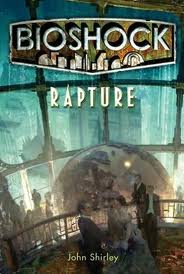
Book Review: Bioshock: Rapture by John Shirley


BioShock: Rapture by John Shirley
430 pages
Tor

If you have followed my blog at all you might have picked up on the fact that my favorite author is cyberpunk legend John Shirley. I am not a fan of the video game, infact I really never ever play modern video games. Infact the first time I ever heard of Bioshock was when Shirley let the cat out of the bag on this project. I really wanted to look at this as an original Shirley piece. It's not that at all, the characters and setting are not really in a Shirley vibe. That is not to say that he wasn't the perfect choice for this book because he really was the best possible author to write this novel.

Rapture is the name of the underwater city that is the haunted house type setting of the the video game. This novel is the prequel that tells the story of how the dream of hyper-capitalist right wing tycoon Andrew Ryan rose and fell. Considering the political upheaval in the story I see why Take-Two thought John Shirley was the person to write this.

Andrew Ryan saw Rapture as the libertarian dream, a nation under the seas hidden from nuclear war(this was in shadow of WWII and the coming cold war) and a chance for the free market to reign. This is the theme of Shirley's upcoming novel “Everything is Broken.” So Shirley does a great job of exploring the challenges that the “free” market of hyper-capitalism would go through in such a packed intense environment.

As someone who never played the video game those are the most interesting parts, not to mention the variety of characters that Shirley had to create to populate this world. The character who becomes the major point of view is the city's plumber (turned bar owner) Bill Mcdonagh who Ryan trusts long after Bill has lost his faith. By that point such a spirit of fear and mistrust has over taken the city.

The weak point for me, probably wont bother anyone who plays the video game. Once the genetically engineered worms that give people super powers showed up I realized Shirley was having fun setting the stage for a video game. I am sure that back story will be fun for anyone who has spent hours playing the game. To me it seemed left field, but like I said I never played the video game.

It seems that Bioshock:Rapture will deepen the understanding and texture of the world created by the video game. That game is considered by many to be one of the smartest out there and the creators of the game found the right author and I think they have done the fans of the game a favor. If your not a fan of the game already I suggest sticking to John Shirley's original cyberpunk like City come a walking or Black Glass.

Friday, November 18, 2011

Book Review: Ex-heroes by Peter Clines


Ex-heroes
permuted press
274 pages

It helps that I read a novel right before this one that I could not stand, but either way Ex-heroes is one of the best novels I read this year so far. It would be easy to describe this novel as Watchmen with Zombies but that is cheap. To me Ex-heroes is the best serious zombie novel I have read since the explosion of Zombie trendy madness. I know I wrote a Zombie novel myself, but if you noticed it was a satire and most of the modern novels make my eyes roll just in concept alone. The reality is that the concept of this novel probably would have caused the same knee-jerk reaction from me if I had not had this book recommended to me by someone I trust.

It would be easy to look at Clines Bio and think that the author was thinking of Hollywood pitch session when he came up with the story. "It's superheroes with zombies," while not a ground breaking concept (see Marvel Zombies), and sure it sounds like a cheesy Hollywood pitch but it doesn't matter. Why? For starters this story is so well told nothing else matters. Clines organized the plot and told the narrative so well that the novel crackles with story telling intensity. Clines told the shit out of this story.

The Story is set in post zombie Apocalypse LA, where a group of former super heroes help a group of survivors live on inside the walls of a Hollywood studio complex. Instead of zombies the walking dead are referred to as Ex's, as in ex-human. Secret identities lose meaning, and the struggle that is life after the end of the world takes a turn for the worst. Could it be that ex's are getting smarter or is their a super villian out there ready to fight the heroes.

The story is told in a non-linear fashion set up in “Then” and “Now” structure. The now chapters are told in third person and the flashbacks revolve between separate first person narratives. In the hands of weaker authors the first person narratives switching voices would not work, but they are perfectly placed in the story so they make sense. Depending on what the story needs the flashbacks either explain previous chapters or set up the chapters ahead in the story. This is all done with a drummer's perfect rhythm.

This is a strong novel so what could possibly make it stronger? “Stealth. Gorgon. Regenerator. Cerberus. Zzzap. The Mighty Dragon. They were heroes, vigilantes, crusaders for justice, using their superhuman abilities to make Los Angeles a better place.” The characters are original and interesting superheroes, which considering how many have been done in the last century is saying something. They are also rich and written with emotional depth.

The suspense beats work will and there are true moments of terror in the novel, not an easy thing to pull off when most of your characters are super humans. Clines also manged to disturb me in a scene where a zombie mother drags her living dead infant down a street with a rope tied to her waist. He left to our imagination, and for me I shuddered at the thought of the dying mother not wanting be separated from her child even in death. Brutal.

I could nit-pick some of the dated humor that comes with cheap jokes about celebrity zombies, but really I laughed most of the time. This really is a near perfect genre mash-up novel. Everybody who knows me, knows I am hard sell as this is a genre I have mocked in my own novel. I am excited for the sequel, and intend to follow the author in the future.

This novel needs to be a movie. Paramount or Warner bros should be in octagon fighting for this one.

Saturday, October 29, 2011

Book Review: Heaven's Shadow by David Goyer and Michael Cassutt


Heaven's Shadow By David S. Goyer & Michael Cassutt
398 pages
Ace Hardcover

The Big Dumb Object sub-genre of Science fiction was the cornerstone of Arthur C. Clarke's fiction(although his best novel Songs of Distant Earth was not in it). He was the master because he was a great storyteller who was not afraid to tell a story with a mystical mystery component but he also knew science. I think it takes some serious nads to get in this ring and try to tell this kind of story in a novel form. The science and details are far more forgiving in a film so I was surprised when two writers known more for film and TV set out to do it.

Goyer is known as a Screenwriter (Blade, batman begins) and director (The Unborn,Blade 3) and his Partner Cassutt (Twilight Zone) had developed the story as a film treatment. I don't work for NASA or know a lot about that world so I can only say that the details seem well researched, and with that element in place I was ready for a wild Sci-fi ride.


The story takes place three years after a Near Earth Object (thought to be a comet or space) is seen heading towards earth. Two space programs are competing to land on the object first. Once they get there the mystery slowly unravels and we discover that of course it's some kind of starship. Don't worry these are not bumpy headed Trek aliens, the authors do a good job of not anthropomorphizing the alien life forms or their technology which is thousands of years beyond ours.

The characters are well defined and introduced with a economy of story time, I would myself caring for them and generally being concerned. I am trying to be general about the plot because I think you are better served going in as blank as possible. I had one small nitpick with the novel that I will address in at the end of this review.

I am a fan of Goyer's writing, enjoyed a talk he gave at a screenwriting conference (in 2003) and was excited to see what he did with the novel form. In much the same fan his one time collaborator Guillermo Del Toro did when he wrote his strain trilogy. You can sense the film just under the surface, mostly in the way the stories cut and weave. The no non-sense approach to the story telling. Heaven's shadow doesn't waste a lot of time with internal monologues and the cuts in the action are pure screenwriting.

That's not a negative. Perhaps the only book I read recently that flowed the same way was Hogan and Del Toro's second book the Fall. The chapter breaks are perfect, and the the various plot threads are paced apart to keep tension high. I saw a review where a reader complained that after a cliffhanger end to a chapter they had to read through four chapters to find out what happened next. Of course the other four threads will building at the same time. That is on purpose ding-a-ling. That's why you read sixty pages of this book without realizing that time flew by.

This is an excellent addition to the the Big Dumb Object genre and my favorite Sci-fi novel I have read so far this year. The authors have built groundwork for a trilogy that cannot stay in the same sub-genre. That's great I am excited to see these characters again and the different direction the story will have to go into. The only real flaw with the novel is something I can see them fixing in the second or the third book. I was thinking it was spoiler, but frankly it's on the dust jacket of the book so...

Like many others who read the book I have a hard time excepting the fact that the aliens feel they need to contact humans for any reason. I am hoping the second book will explain why in the second book because to me it's still mystery. Is that a nitpick or not? I can't tell until I read book two, and that is already on my list.

Saturday, October 8, 2011

Book Review: Bible Repairman by Tim Powers


Bible Repariman by Tim Powers
Tachyon
192 pages
$14.95 Trade paperback

I have long been a casual fan of Tim Powers and his work. I've always found his science fiction to balance grand idea with excellent writing and strong characters. I have read only novels in the past. I was a huge fan of his novels Three Days to Never' and "The Abunbis gates". The Bible Repairman is a collection odd surrealist borderline bizarro speculative fiction. No space opera or generic sci-fi themes this book is really one for highly literate and patient fans of high quality weird literature.

I really enjoyed the stories "Soul in the Bottle," a tale centered around a book collector and his fascination with Jean Harlow's star on the walk of fame, and "Hour of Babel" a neat time travel story inspired by the pizza joint that Powers worked at in the 70's. The writing in all the stories are high quality, Powers has master's level talent. The only story I could do with out is "Time to cast away stones" the final story in the collection, that bored me to tears. The subject matter about Bryon and Shelly did nothing for me personally, I understand this is a postscript to a novel Powers wrote called "The stress of her regard." Perhaps if I read that book I might have been more interested but to me that was a weak point in a otherwise perfect collection.

I think this is a good book for librarians to stock in their collection and to display, as I am hoping it more attention. It's neat collection. I am not so sure I would tell readers they need to rush out and buy it but that is why it's perfect for the library.

Book Review: Embassytown By China Mieville


Embassytown by China Mieville
Del Rey
352 pages
$26.00

I was very much looking forward to this book. China Mieville has got to be one of the smartest genre authors out there. I saw him speak at a book signing at Powells promoting his book City and the City a few years back. Just as I had when I listened to interviews I found myself thinking, wow this is one smart dude. He is in fact one smart dude, and like many of his other novels Embassytown is themed somewhat around the multi-dimensional life-form that is a city. (Another great sci-fi novel about a city is John Shirley's Classic 'City Come a Walkin')

I was excited because the idea of Mieville who has written mostly steampunk-ish fantasy or otherwise surrealist new weird fiction doing hard Sci-fi sounded great. From page one Mieville creates a strange landscape of the far future in way that reminds me of 'Left Hand of Darkness' by Ursala Leguin or 'Crucible of Time' by John Brunner. Were talking seriously speculative fiction, all three novels are in such alien worlds it is sometimes easy to forgot a human wrote the book at all.

It is the tale of a city know as Embassytown on a planet colonized by humans. The planet is home to a species called the Ariekei who speak a unique language that only a few genetically altered humans are able to speak. To speak it they have to be cloned and two doppel humans have to speak it together, these ambassadors eventually because a important part of the Ariekei culture. The hosts become addicted to the sound of their voices, and some ambassadors die, others come into power and the novel explores the social fabric of this alien society.

Some of the things I respect about this book are the very things that frustrated me about it. I am a quick reader and I slogged through this 352 pages over weeks. I often had to re-read paragraphs over and over, especially during the first quarter of the book that felt more like a anthropologist's memoir that a narrative. Of course in the universe of this novel, thousands of years into the future with humanity spread out across the universe Language and terminology itself would be alien to us. Mieville throws us in to the deep end without swimming lesson here. I learned those terms quickly enough, as a brief example deep space is referred to as “The Out,” and space Travelers are “Immersers.” The novel is written as if you already know that, I am not complaining I liked that choice and to a serious genre reading this is not that new of a concept.

Unlike Leguin's Left Hand of Darkness I felt the “gee-whiz” factor of the ideas constantly got in the way of the story. I felt like I was so busy trying to figure out what the author was trying to say about language and decipher the ideas that I had trouble following the narrative.

It would be easy to read this novel and think that it was simply a exploration of the power of language. It is that, but the novel also explores the concept of the relationship between the colonizer and the colonized. I think there are amazing elements to this novel, but I can't give it more than three stars out of five because of what a struggle I had keeping my interest. I respect China Mieville enough that I think there is a strong possibility that I am just not smart enough to follow some of the concepts, but I feel he could have kept the story closer to the surface and it would have been a better novel.

Saturday, September 3, 2011

Book Review: The Urban Fantasy Anthology by Peter S. Beagle (Editor), Joe R. Lansdale (Editor)


The Urban Fantasy Anthology by Peter S. Beagle (Editor), Joe R. Lansdale (Editor)
Paperback, 432 pages
Tachyon Publications

Ok lets make something clear upfront I am a fan of sub-genre, and as a concept I am fine with the idea of urban fantasy. One of my favorite reads last year was King Maker by Maurice Broadus which was basically gangland version of King Arthur’s court set in modern Indianapolis. That is urban fantasy, and The Crow is another fine example. Alot of my favorite stories in this collection are ones that just seemed like horror, but I am biased I suppose since horror is one of my favorite genres.

This board and diverse anthology features three sections Mythic Fiction, Paranormal romance and Noir Fantasy. Each section comes with an introduction about the sub-genre of the sun-genre and honestly those essays were my favorite part of the read. The Mythic fiction essay was written by Charles De Lint, the Romance one by Paula Guran(long time editor, agent and Cemetery Dance columnist) and bestselling author Joe R. Lansdale.

As for the stories I honestly felt my eyes rolling a lot and and many of the zombie love stories, zombie private eyes, vampire at rave yadda yada led to a lot of subconscious skipping around and less than memorable stories.

My favorite stories were the bizarre surrealist tale “Bible Repairman” by Tim Powers, “Haunted house of my very Own.” By Kelly Armstrong and the classic by Joe R. Lansdale’s "On the far side of the Cadillac Desert with Dead Folks,” Which I read when it was released in Skipp and Spector’s classic zombie anthology “The Book of the Dead.” I was too young to understand the story the first time I read so it was awesome to relive it.

The reality about my favorite stories were they seemed like horror tales and not urban Fantasy, but what do I know. I do think regardless of my opinion as a reader and a critic this book SHOULD be in every library collection. This is a growing new sub-genre and I think this book is an important look at how and why it exists.

Should be noted that if your looking for gritty urban horror and noir of the fantastic. Joe R. Lansdale and the same publisher put out a book last year called Crucified Dreams. I reviewed on this blog, I think that was a a far superior collection.

Monday, August 22, 2011

Book Review: Flashback Dan Simmons


Flashback by Dan Simmons
560 pages
Little Brown and Company

Dan Simmons is a brilliant novelist, and perhaps one of the greatest genre authors working today. The intelligence and versatility he has show in sprawling epics such as Carrion Comfort(A vampire horror novel) Hyperion (far future hard sci-fi) to historical epics like Black Hills is amazing. I can't state enough the level of respect I have for the writer and the novels he has written. That being said I have mixed feelings about his most recent Science Fiction novel Flashback.
Flashback is a long hard boiled mystery set deeply in the apocalypse dystopia genre that blurs the line between Science Fiction and Horror.

Speaking with the Agony Column podcast Simmons went as far as to say he didn't think of it as Sci-fi, He might not like the analogy but the plot and the basic concept also had a bit of a cyperpunk feel. The dystopia warning novel is a well respected genre that critics often elevate out of the genre ghetto and Simmons seemed intent on writing a modern Alas Babylon or Brave New World. A huge number of Americans believe our country is going down the wrong path and Flashback is a Simmons exploring that concept to it's worst possible conclusion.

The plot is great, and expansion of a Simmons novella which was written when Simmons had somewhat different political views. Nick Bottom is a detective, he is private now since his addiction to a drug called Flashback has kept him from the force. Flashback causes the user to to re-live in a near catatonic state the happiest moments of their lives for a one dollar a minute, the really bad part is 87% of America is addicted to it. The country is falling apart, Texas is a separate nation, Mexico controls the southwest, and Islam is taking over the world.

Nick Bottom is hired by a Japanese millionaire to investigate the murder of his son on american soil. He tries to solve the mystery by using Flashback and working with one of the businessman's personal ninja bodyguards. The relationship between Bottom and the Japanese body guard Sato is one of the highlights of the novel.
So what did I think of the novel? Well I read the whole thing, and I read it fast, Simmons is of course a skilled writer, so in his hands I had a enjoyable read in many ways. In the end however I cannot recommend this novel. It's not just because of the politics, which are entirely loony right wing nonsense. As the author of a novel called “The Vegan Revolution...With Zombies,” I know a thing or two about writing political novels, and certainly have read novels I didn't agree with before, and even liked a few of them. When I wrote Vegan Rev. I was very concerned that the story, and the characters came first, that I would not bend the novel to fit my views. That being said that novel was a satire. I think Simmons might have been better off fully inserting his tongue in his cheek.

While not as transparent and ideologically consumed as Crichton's State of Fear, that book was simply unreadble. Simmons wore his heart so much on his sleeve that he took his eye off the basic plot construction and prose that have made him a giant in the field. I honestly think it is Simmons weakest novel. Parts of the mystery are conveniently are withheld for no logical reason, cringe worthy right wing inter dialogues distract from the pace of the story, and the history of the future take on insanely unrealistic nature to fit Simmons's views. That's his right, it's his novel, the problem for this reader is that some of those future histories were so ludicrous it took me out of the novel. In a satire sure, but this was not a satire. The worst example is a off handed comment about the mayor of NY being the Imam of the mosque, my memory might be off but he may even be the the vice president too. You see just at the edge of this novel is a creeping fear of that the Arabs are going to take over the world.

In that same Agony column interview Simmons claims that he is a political centerist and he expects the book to anger readers both on the right and left. No way, this book is a right wing nut-fest only separated from Glen Beck's chalk board rants by the author's sharp story telling skills(which in my opinion have never been more dull). In 2006 Simmons created a shitstorm by publishing an essay on his website called message from a Time Traveler, linked here(www.freerepublic.com/focus/f-news/161014...) which many - myself included see as a racist far right call for war with the Arab world. Flashback is not only an extension of those ideas but he breaks lots of new ground. Bashing left wing intellectuals in general (and Ward Churchill specifically), left activists(who are just tattooed and pierced idiots), denying global warming, bashing global climate scientists, a world that sits back and allows a second holocaust of Jews and portraying the Japanese to be even more evil than a Hong Kong movie would dare. (After the Japanese treament of the Chinese in WW II, it's not shocking that a huge % of HK movies have Japanese villains, not sure what Simmons has against them)

I am glad Glen Beck is already off the air on Fox because I could really honestly see him loving and blurbing this novel. When I finished this novel it had me wondering what Simmons thinks about the recent Arab spring, where people in several Arab countries rose up on their own demanding freedom. Many are dying today fighting for freedom in Syria, Iran and Libya - that doesn't jive with the fear mongering peppered throughout this novel. The story it self is entertaining, but Simmons is not up to his usual high quality, unless you have exhausted your Dan Simmons novels I would suggest going further back in the catalog.

Monday, July 18, 2011

Book Review: Jim and the Flims by Rudy Rucker


Jim and the Flims By Rudy Rucker
247 pages $24.99
Nightshade books

Rudy Rucker is a well know cyperpunk Science Fiction author and he is also well know for being a mathematician and computer science professor. He is also the editor of Sci-fi's best web-zine Flurb (I may be bias because flurb published a story of mine). Fiction wise he is best known for a series of four cyberpunk books that were kicked off by the classic novel Software. (I reviewed Software back in October 2010 on this blog). To say that Rucker is a genius to me is a understatement. He writes stunningly original, funny and above all smart Science Fiction.

His observations on the craft of writing Science Fiction are well documented in interviews done over the years with the amazing Agony column podcast. One of my favorite concepts Rucker introduced in one of those interviews was the Sci-Fi Power cord. He talked about how certain tropes in speculative fiction such as androids, flying saucers, Alien invasions should not be looked upon negatively as cliché, no more than the power cord in a AC/DC or Ramones song. Through his long career Rucker has explored these power cords always putting a unique spin on familiar topics.

I knew I wanted to read this book when Rucker said after recovering from a health scare he decided to write a book about traveling in the afterlife. Rucker didn't see any light at the end of the tunnel, but was inspired to explore the idea. What we end up with is a novel that is kind of like Matheson's What Dreams May Come' meets Slacker.

It is the story of surfer slacker Jim Oster, a former bio-tech engineer turned mailman who accidentally cuts a hole in a electron and sets off a chain of events starting with the death of his beloved wife Val. In this novel the after world known to it's residents as Flimsy is not above us in the heavens but all around us in each and every electron. This leads to my favorite dialogue from the novel, “Heaven is everywhere. It's a hall of mirrors, but over here only one electron has a nick, thanks to you fuckhead.”

You see, Jim created a tunnel, not only has he some of the various species of flims escaped to earth, but he is given the chance to leave his body and search for his wife in Flimsy.

This is where things get weird, really bizarro. Rucker takes us on a wild adventure across flimsy, a land made up of strange creatures and landscapes. I can hardly do them justice in this review. In Flimsy water flows across the sky, flying intelligent beets, and blue baboons run amok. The characters travel across the land on a cruiser couch that Jim makes with his mind out of a material called Kenessce which all flimsy is made out of. Along the way the book also has has one of the most bizarre sex scenes between Jim and a woman also discovering her astral body.

Jim has to navigate the strange community of Santa Cruz surfers and flims so he can not only find his wife but of course save the earth. Rucker's strength is an amazingly bizarro creative imagination that matches his obvious intellect. Unlike many bizarro books Jim and flims finds humor without appealing to the gutter. The prose has a whimsy, that a lot of science fiction lacks, and frankly could use. It reads like a lucid dream, the kind where you wake up laughing and wondering how your brain came up with that.

So yeah, Rudy Rucker strummed this power cord with a lot of gusto and I think if you have not read his stuff before it's a excellent place to start.

Saturday, June 25, 2011

Book Review: Super amazing and brutal Post Apocalyspe novel 'Through Darkest America'


Through Darkest America By Neal Barrett Jr. (Issac Asimov Presents)
259 pages
(Out of Print)


I can't believe this book is out of print. I can't believe this is not considered a classic. I don't say that lightly. Probably my my favorite subgenre of fiction is the post apocalyptic epic – the Stand, Mad Max, the Road and hell I even liked Book of Eli. This wasreleased the same year as the book I considered the greatest in the genre - Swans Song by Robert McCammon. I admit that I have no experience with author Neal Barrett before reading this book, but to say I was blown away is an understatement. This book slapped me around while I begged for more.

While this novel is certainly Post apocalyptic it feels like a western. It explores issues of violence and inhumanity, ecological devastation and in my mind does almost as good a job of exploring humanity's messed up relationship with animals they consider to be food as any animal rights book I have ever read. It is one of the single darkest and brutal novels in a subgenre speculative horror that is well known for being brutal. If I have already sold you do yourself a favor and buy a used copy on amazon(this book is not easy to find), because I have to give away some early plot points to talk about why this novel is so brilliant.

Through Darkest America takes place sometime after a great war, was it a nuclear war? Biological warfare? The author doesn't explain but we do know it was several generations in the past. Our main narrator is Howie Ryder son of a livestock farmer who provides meat for the government fighting rebels out in the western frontier.

You might think this sounds pretty normal but after the war, the majority of the mammals have died out sometime in the process of the war. A few prized horses are left to be used transportation, so what so the people eat? They eat stock. What are stock? Well as Howie's dad explains to him Stock look like humans, but they are not. You see Stock don't speak and they don't have souls.

Just as Howie is set to take over his father's herd, He witnesses a brutal crime. A group of soldiers sexually assault a female “Stock.” Howie's father kills the rapist and gives Howie a speech about what separates people from stock. Howie is confused because the victim looked human, he even found her attractive. This incident sets off a chain of events that ends with the killing or kidnapping of his family. Howie barely escapes.

The rest of the novel we go with Howie on a coming of age journey that includes him joining an old fashion cattle drive, except the drive is made of stock. Along this journey Howie falls in love, and questions the leader of his gang. I refuse to give away the very end but it sets up a sequel I am dying to read.

Through Darkest America being out of print is a crime. This might be one of the most important works of speculative fiction I have ever read and it's only dumbluck that I read it. You see a couple months ago I picked an issue of Twilight Zone magazine publish in 1988 at a vintage store. In this issue Through Darkest America was reviewed on the same page as Robert McCammon's Swan Song( as I mentioned above). As soon as I read the review I knew I had to read this book. That wasn't easy since it's out of print, I looked at every used bookstore, library I could but I had to break down and order a used copy off amazon.


The story works as a coming-of-age story, it works as a post apocalyptic epic and most of all it is a gritty tale of the wild west. More than anything it is a slap in the face that explores many issues. He might not be vegan I would think Barrett is at least a vegetarian. As a Vegan myself the idea of “stock” in cannibal America is not much of stretch. Since this book was written before terms like “free-range,” and “Humanely raised” are used and argued with in many of the same ways Howie's dad explains the ethical reasons behind raising Stock.

Just as meat-eaters try to explain away the emotions, and feelings of so called “Livestock animals” the characters of this dark future dismiss the lives of their food. They are just souless stock after all. As you might guess the ethical standards for what makes someone a person or stock gets blurred. In the end Howie discovers truth about stock. They can't talk because they are disfigured, they can't rebel because they have never been taught and their spirits have been broken. And just as we have that truth revealed the book ends setting up perfectly for the sequel.

As speculative fiction author who means to express himself on important political and social issues I have never been so jealous of a novel or an idea. A genius work speculative activism, this novel should be a goddamn classic. Read it. Think about it. Maybe if enough of us write about it, Barrett can get it back into print.

Wednesday, June 1, 2011

Book Review: Fathers and Sons: Blackguard Book one by Edward R. Morris


Fathers and Sons: Blackguard (Book one) By Edward R. Morris
242 pages
The Borgo Press (Wildside books)


I am a sucker for many things this novel does well. Blackguard does not fit in to one speculative fiction subgenre perfectly but what it does is blend a lot of them together. Edward Morris is an extremely well read genre writer. He wears his influences on his sleeves like patches sewn on on punk rock leather jacket. What we end up with is an edgy novel that is not quite cyberpunk, military sci-fi, First Contact story or distopia. It is all those things and more.

Written in the similar non-traditional structure as Brunner Classic “The Sheep Look Up,” don't expect they same tired tropes of sci-fi structure. It is the story of several characters who lives are somewhat connected by the mile long uber dance club that future downtown Portland Oregon has been turned into. Sean Mallory is our primary character and after being upgraded mentally and physically by the military creates a new life for himself by starting a team of bouncers called the blackguards. It is their job to secure a dance club the size and scope of which is beyond anything we know.

One of the best characters of the novel Kano is a man Mallory met in the japan during a future war, Mallory also has a son who is fascinated by the life his dad leads as a bouncer. Character wise we learn a lot about Mallory philosophy of bouncing which is informed by experience and eastern philosopher. This suggests a direction in the future books in the series, Mallory likes samurai books and The Art of War.

Morris forces you to get to know the characters before he includes us in on the future history, he avoids the traditional science Fiction disease of “info-dumping” by spending 78 pages building the world. So don't expect this new world to be dumped in your lap. The strangest part is a subplot about first contact with extra terrestrial species that has been watching us.

Morris appears to hiding the direction of the next books in plain sight. The Aliens have arrived but it doesn't seem to be much of a big deal at first. Is this an author slight of hand? This appears to be one of few weaknesses of the novel, the non traditional structure might turn off some readers. I hope not the The characters are strong and the action is exciting.

Morris is a gifted writer that never wastes a word. This brilliant work blurs the many sub-genres of speculative fiction in to a potent cocktail. A work of high literature that explores characters forced into the chaos of an all to possible future. A punk touch on a gritty style makes this novel a MUST-read. Portlanders take note this novel is very much about the rose city.

Review: Eco-horror classic JG Ballard's The Drought


The Drought by JG Ballard
192 pages
(out of print)

Ballard like a lot of amazing writer's is better know for the films based on his excellent work. Despite several decades of during excellent thought provoking science Fiction novels that managed to crawl out of the genre ghetto to be praised as literature. His most well know work is a semi-autobiographical novel Empire of the sun made into a film by Steven Spielberg, his most famous Science Fiction novel Crash was made into a film by David Cronenberg.

The drought is a fantastic work of both horror and Science Fiction, a gut wrenching and brutal look at one small corner of the world dealing with a ten year drought that nearly ends our species. As a work of speculative eco-horror it ranks with classics in the growing sub-genre. What is most stunning is when it was written, in the middle 60's just few years before fellow British Science Fiction writer John Brunner wrote his eco-horror classic “The Sheep Look Up.”

In the last few years Brunner's novel about chemical pollution and Government manipulations by corporations has been heralded as Prophetic, but Ballard's work is no less telling of a future we are just now seeing come into focus. Just this last week I heard Worldwatch founder Lester Brown on NPR's Fresh Air talking about a coming global food crisis. Population growth, a shift to a western diet, and climate change are creating a world where we have to worry about wars over water, not oil.

But even more directly Ballard's novel suggests the drought is caused by chemicals creating a lifeless dead zone off the shore that prevents evaporation and rainfall. He wrote this in the sixties and now we have an island of plastic forming in the pacific ocean the size of Texas. IS it the same thing? No but it is scary none the less.

The novel follows the character of a Doctor, as he tries to stay at home as the world drys out. While some of the depths to which the characters go to survive might seen tame compared to recent post apocayltic fare, it is pretty hardcore for it's era. The story is well paced, and moves quickly through it's short page count. It should be in print, considering the issues we face in the coming century it is a story that needs to be heard. This kinda of warning is what speculative fiction does best.

It also makes you wonder how recent Eco-horror classics like John Shirley's Demons, and Skip and Spector's The bridge will be judged further down the line.

Wednesday, May 11, 2011

Book Review: King Maker by Maurice Broaddus


King maker: The Knights of Benton Court 1 by Maurice Broddus
412 pages
Angry Robot

This is an excellent and original first novel of urban fantasy, with dark horrific over tones. King maker is most easily described as King Arthur's court in reset in the ganglands of Indianapolis. Having grown up an hour south of Indianapolis, I grew up going to Indy to go to sporting events, metal and hardcore shows. So I was interested in this novel that took place in a city but familiar and unknown to me.

I think many of my friends who has lived in or around Indianapolis might still feel they have a little to learn about the from the point of view Broaddus provides. I admit I probably enjoyed the geography and local references a lot but there is plenty to like even if you have seen been to Indianapolis.

This book is a origin tale and has the difficult task of setting up characters who stand-in for King Arthur and his knights. Not to mention all the gang riff raff they have to deal with. It was smart to include a a chart at the front of the book.

The fantasy elements are pretty restrained, and only appear in small doses until the end of the book, also it sets up the future books having a greater level of fantasy. This worked for me as Broaddus focused his energy on building strong and well defined characters. In this sense the first ¾ of King maker has more in common with The Wire than Excalibur. This is an excellent choice on the author's part because more than most Urban fantasy novels the world felt raw and real.

This is an excellent debut, but it is an origin novel and it's strength lies in strong characters and the road ahead. It's fortunate that Angry Robot has already released books two and three. They are already on my list.

Wednesday, February 9, 2011

Book Review: The Fall (Strain book Two)


The Fall by Guillermo Del Toro And Chuck Hogan

309 pages

William Morrow


Guillermo Del Toro is to horror geek-dom what Eddie Van Halen was to guitar playing in the 80’s. A master who can do no wrong, his films, his art, and now his novels are fantastic. I feel bad because Chuck Hogan who is also a bestselling author seems to be overshadowed by GDT(literally and figuratively). There is a good reason for that beyond the fact that movies are more popular (although the success of “The Town” will help), the strain trilogy is very much Del Toro’s baby. He can and will write novels on his own some day I am sure, but he teamed up with Hogan because Hogan had skills to write the police procedural stuff.


I liked The Stain book one, it was a great introduction. The authors have said that each book stand alones, and while that sounds nice, I am not sure that is true. The first book is a great introduction to the characters, and as the second book does a good job of reviewing the events it would be a shame to miss out on the first book. That being said the first book is not as strong as the second.


The story of The Fall lends itself to kicking ass. The first book was world building and information dumps it was a lot of stuff as a novelist you have to do. How do the Vampires work? Who are the characters? What are the rules. So for book two we have all those things established and we are ready to rock.


I knew I would dig this book, I love a great end of the world apocalypse novel, McCammon’s Swan Song is perhaps my favorite and while it’s not as sprawling as swan song or as intimate as I am Legend the strikes perfect balance. Not too long, not a lot of wasted fat, the story cooks along at a great pace.

It also ends with a great cliffhanger and set up for the third book that makes you wonder why no other vampire author ever thought of the end these two did.


The Fall follows the same characters Eph Goodweather the CDC guy, Fet the exterminator, and Vampire hunter Setrakian. It deepens their story and that of the Vampire ancients and master. Also introduces new characters like a retired Mexican wrestler now as the silver angel.


The pace is exciting making it a quick read, the characters are solid and fleshed out without wasting word count on it. The chapters split back and forth between setting and characters with such perfect pacing that you feel like your watching film. The film editing and writing influence GDT brings to the table works really well in this novel.


Near perfect science fiction horror end of the world novel with the addition of a vampire mythos, how can you go wrong? You can only go wrong by missing the chance to read this.

Monday, February 7, 2011

Book Review: He is Legend a Tribute to Richard Matheson


Richard Matheson is one of the greatest living writers in any genre but in the fields of Science Fiction and Horror he is a giant. To the mainstream you can always say he is the guy who wrote and name any of several classics. People know and love his work but often don’t know his name. The man behind several of the best Twilight zones, I am Legend, Somewhere in Time and Duel to name a few.

He is Legend is a long overdue tribute to Matheson. This anthlogy has sequels and companion pieces to Matheson tales by Stephen King, Joe Hill, John Shirley, Mick Garris, F.Paul Wilson, William F. Nolan, Gary Branbeck, Thomas F. Monteleone and many other giants in the field.

Fans of Matheson should find this book to be essential. There are no stinkers in this collection, but favorites came early in the collection. Throttle is a excellent sequel of sorts to Matheson’s story/screenplay Duel written by father and son team Stephen King and Joe Hill. This is a great piece and had sentence that made laugh hard enough I put the book down.

Mick Garris has interesting prologue to I am Legend written from thye point of view of the annoying neighbor Ben Cortman. Another favorite is John Shirley’s companion piece to Matheson’s classic Somewhere in Time. In Shirley’s piece a historian uses the same method of time travel to try and stop the events at the OK Corral.

Now that is book is out in trade paperback, it’s great way to celebrate one of the greatest 20th century writers to ever expand the genre.

Saturday, December 11, 2010

Magazine Review: Dark Discoveries #17


Dark Discoveries #17


I posted a review of another horror magazine Cemetery Dance last month, now time for a review of my favorite. The locally produced Dark Discoveries. Editor James Beach and his partner Jason Brock have done it again, making each issue better than the last. Without a doubt this is my favorite issue so far. The Dark Science Fiction issue features stories by Ray Bradbury, John Shirley, Jeffery Thomas, Bruce Taylor and Portland’s own Jeremy Robert Johnson.

All the fiction in this issue is top notch in this issue. Jeremy Robert Johnson’s The Oarsman was exciting to read as he is a gifted author who has been in hibernation for the last few years. This is a short science fiction, but it doesn’t take long to show a growth in JRJ’s use of language. He was already a great writer but I loved this story.


John Shirley has an excellent short called “Raise Your Hand if You’re Dead.” This returns Shirley to familiar territory that will excite his fans it is cyberpunk with a subtle but effective environmental setting.As is the case with the best short stories I finished it wishing it were a novel. Bruce Taylor's tale of surrealist humor he is known for and the Bradbury piece is poetic.

As for the non-fiction the highlight for this huge fan was Jason Brock’s excellent interview with John Shirley. A great introduction for readers unfamiliar with his work and for those of us who have read everything a peak a little deeper into the writer’s mind. I enjoyed Nolan’s piece about Phillip K. Dick and James Beach’s piece on Dark stories of Star Trek the original series. There were fascinating features abut J.G. Ballard (a writer I need to explore), Rod Serling and lots more.

Jason Brock continues to make the magazine look better with each issue. It’s clear he puts a ton of energy into the look and design of DD. It looks light years better than it did a few issues ago.

I only have one small problem with this issue and one with Dark Discoveries in general. The small problem first, I was excited about the David Cronenberg interview as it was the Dark Sci-fi issue. I was hoping for a look back at videodrome, scanners and the other fantastic films he made that crossed both genres. The interview was almost entirely about Eastern Promises. A good film, and a good interview but a small let down. I don’t blame The DD crew for including it, I just have to admit I was hoping for some dish on the early films.

Now for the only big, huge problem with Dark Discoveries! It’s so damn good I read it almost all in one sitting. Granted It was over a whole afternoon, but I slammed through this issue, and I did that the last two times as well. Now I gotta wait for another issue. I’ll be keeping my subscription.

Wednesday, December 8, 2010

Book Review: The Black hole of Carcosa by John Shirley


Kamus of Kadizhar: Black Hole of Carcosa
John Shirley
1988 St. Martin’s press
(Out of Print)

I have not worked my way through every book that cyberpunk and extreme horror pioneer John Shirley has written, but I have read the majority. Black hole of Carcosa is the most bizarro one I have read so far. 1988 is way before the bizarro literary movement kicked off but this book has more in common with the likes of D Harlan Wilson than it does the vulgar insanity of Carlton Mellick III.

Set on Darkworld a future human colony where technology doesn’t work but magic does. This is the surreal setting where noir style Kamus of Kadizhar is the world’s only detective.

I wouldn’t say this book is a satire, but it is as tongue and cheek of a science fiction novel I have read in a long time. So even though the plots are very different that is why it reminded me of D Harlan Wilson’s amazing science fiction surreal comedy Dr. Identity. If you compare the two Dr. Identity may seem a little bit more gonzo consider the time and place in his career that John Shirley was at.

Rudy Rucker was in a lot of ways cyberpunk’s comedian, and Shirley was at the time in the middle of a dark trilogy of world war III novels. The Song Called Youth Trilogy was a brutal look at the growing conservative fundamentals, so a whacky tongue in cheek surrealist comedy at the same time was a bold move in 1988.

Now there is a movement and peers that support this kind of off the wall novel, but at the time I think this was a pretty bold novel. Bizarro fiction fans need to find this book if they can. Maybe if its cult status grows Shirley can write sequel set on the punk rock planet mentioned on page 43. That would be awesome.

Sunday, October 24, 2010

Book Review: the Skinner by Neal Asher


The Skinner By Neal Asher
Tor
424 pages

My first time reading Neal Asher was a far future bizarro science fiction short novel called Africa Zero. This is a longer more epic tale, but it is also one of the most bizarro modern Sci-fi novels I have read. It has sold me on Asher as a bold new voice. Entertainment weekly called it Dune meets Master and Commander and I can't disagree with that. The plot and and setting are so strange that I struggled a little bit trying to explain it to others.

It takes place in the same “universe” as Asher's first novel Grindlinked, I have not read that yet, but I don't think I suffered much for it. This is a stand alone novel.

Not since Dune has the landscape and ecosystem of a world come to such vivid life. What is most exciting about that is Spatterjay, the planet where skinner takes is what a horrible place to be the planet is. It makes the novel feel icky in a way. This is not a world where you want to take a vacation. SpatterJay, named after Jay Hooper the human who found the planet is mostly ocean. But the planet is teaming with life, including leeches both giant and small. The ecosystem is so interactive after a few bites from the leeches human are integrated in way that makes them almost immortal. Jay was using this unique ecosystem to take murdered humans, re-animated and devoid of life to be sold to the Prador, a crab like race the humans were at war with.

Humans who live on the planet are called Hoopers, and most have lived hundreds of years constantly being rebuilt by the leeches. This is explained well as two hoopers in one part fight in a tearing each other up, their bodies keep repairing themselves.

The book opens following a few humans as they arrive on the planet. My favorite of the characters are Sable Keech And Janer. Keech is A monitor (Basically a cop) who has been hunting a this planet's funder for 700 years after his death. How is that you ask? He is cybernetic his dead body linked to computer that stored his mind. His target is not doing much better, Jay Hooper's (known also as the Skinner) body has been living with out his head. Spatterjay seas captains have been keeping it alive in a box.

As for Janer he is a human who was punished for killing a hornet after he served his time as host to a hive mind of sentient hornets. After his time is up he stayed with the hive mind and is traveling the universe looking for adventure.

At the same time the human race is in a time of peace after years of war with the Prador,but They also want to kill the skinner and any other witness to the war crimes they committed together. The only part of the novel I did not enjoy were the seemingly endless battles between the Polity A.I. Who oversaw the planet and the Prador. That stuff wore me down a bit in the last 100 pages.

None the less I loved this inventive, brutal and super fucking weird science fiction epic. Asher made a fan out of me with this novel and I'll check out his other work for sure. Along with Richard K. Morgan, Neal Asher and China Mieville it seems the most exciting speculative fiction belongs to england.

Classic novel Revisited: Space Vampires by Colin Wilson


Space Vampires AKA(Lifeforce) By Colin Wilson
216 pages
Out of print

This science fiction horror crossover is remembered mostly from the Cannon films adaptation of the novel. The film while produced by Cannon films the schlock studio behind the cinematic ascension of Chuck Norris and the Sho Kosugi Ninja trilogy is not that bad. They certainly hired excellent cast and crew. Directed by Texas chainsaw massacre director Tobe Hooper, adapted by Alien Screenwriter Dan O'Bannon and scored by Harry Mancini. Lead by an impressive bat shit crazy performance by Steve Railsbeck, a small role by the future enterprise captain Patrick Stewart and of course the naked space vampire who excited overly hormonal horror fans by walking around London naked played by Mathilda May.

It was sci-fi and horror so I have seen a few times over the years. Recently I saw a tie-in paperback on the shelf at powells and thought I would give the book a shot and re-watch the movie. The first 80 or so pages of the book I was impressed thought it was much better than my memory of the film. First off I think the novel takes place a little further in the future. The discovery of the “stranger” spaceship and the discovery of the vampires is handled excellently. The creepy-ness of finding a old dead space ship in space is well done and I felt the charcters nervous-ness come through the text.

“The stranger ship” in the novel has a very cosmic horror, lovecraftian-ness that exists in the novel but it is deeper in the book. One of the blurbs on the cover called it fast paced. Yes at times it was fast paced too fast paced, some times scenes and action transitioned so fast and I to go back and re-read sections. Wilson just skipped ahead if the part of the story bored him at least it seemed to me.

Any of my friends on Good reads might notice that I started this book in July and finished in October. I am a fast reader generally. But once this book hits the wall. For 20 or 30 thirty mind numbinging pages the main character Carlsen gets a history lesson on vampires. This is meant to connect traditional vampires to the three energy sucking space vampires. The major difference between the movie and the book is O'Bannon didn't use any of this material. Good on him, it is boring ireallavent and just straight ruined the main work of the first 80 pages.

The movie turned out a little better. Yep it's one of those rare cases like Children of Men or the English Patient where the film is much better than the book. While the movie comes off now as campy, and little over the top most of that is due to being out of date. Perhaps it seemed less cheezy in 1985,certainly when I watched it in the 80's it looked better to me.